

A good product does not automatically become a remembered brand. You can have a strong service, a well-designed website and a healthy marketing budget, and still find that customers know your category but cannot recall your name.
That gap is what a brand awareness expert works on. Brand awareness is not about collecting impressions or followers. It is about helping the right people notice your brand, recognise it, understand it, remember it and consider it when the need appears.
I treat that journey as a connected system rather than a single advertising campaign. Depending on the business, it can involve positioning, messaging, creative, content, social media, SEO, paid media, video and measurement.
The exact combination changes from one business to the next. A local Chennai business needs a different awareness strategy from a B2B technology company, a D2C product or a startup entering a new category. Whether you call the role a brand awareness consultant or a brand visibility expert, the job is to understand that difference and build the strategy around it.
Table of Contents
What Is Brand Awareness?
Brand awareness is the extent to which people know, recognise or remember a brand. But awareness has levels, and they are easy to confuse.
- Someone may have seen your logo without knowing what you sell.
- They may recognise your name without considering you when they need your product.
- They may remember your brand but associate it with the wrong category.
Strong awareness is therefore not about appearing in front of more people. It is about creating the right memory in the right audience.
This is also how researchers treat the subject. NielsenIQ’s brand awareness overview separates general awareness from recognition and perception, because each one tells you something different about how well people know a brand.
Brand Recognition vs Brand Recall
These two ideas are closely related, but they are not identical.
| Brand recognition | Brand recall | |
|---|---|---|
| What happens | A person sees your logo, packaging, advertisement, colours or name and thinks, “I’ve seen this before.” | A person is asked which brands come to mind for a need, and names yours without being shown anything. |
| Type of awareness | Aided awareness | Unaided awareness |
| What it tells you | Your brand assets are familiar | Your brand has a place in memory |
Harvard Business School’s brand awareness guide describes recall in the same way: how likely an audience is to remember a brand without a prompt.
For me, the stronger goal is not “people have seen the brand.” It is “people remember the brand for the right reason.” The highest level, top-of-mind awareness, is when your name is the first one that comes up. That difference should shape the strategy.
What Does a Brand Awareness Expert Do?
A brand awareness expert should not simply tell you to post more content. The real questions come earlier, and each one needs a clear answer before any campaign is planned.
| The question | What you need |
|---|---|
| Who should know you? | A clearly defined audience |
| What should they remember? | One focused brand association |
| Why should they believe you? | Proof, credibility and consistency |
| Where should they encounter you? | The right channel mix |
| How often should the brand appear? | Meaningful repeated exposure |
| How will you know awareness is improving? | A measurement framework |
The job sits between brand strategy, digital marketing, creative direction, audience understanding and measurement. A good brand awareness consultant can move between all five without losing the thread.
Brand Awareness vs Branding
The two are related, but they answer different questions.
| Branding shapes | Brand awareness focuses on |
|---|---|
| Identity and visual system | Visibility and market presence |
| Positioning | Recognition |
| Voice and personality | Familiarity |
| Messaging | Recall |
| Perception | Audience exposure |
A business can have a beautifully designed brand and still have low awareness. It can also have high awareness and weak positioning. That is why the two need to work together.
My work as a brand strategy consultant focuses on positioning, messaging, identity and strategic direction. The awareness side takes that foundation and asks a different question: how do we make that brand known and remembered by the people who matter?
Brand Awareness in Digital Marketing
Brand awareness in digital marketing does not belong to one platform. Each channel creates a different kind of exposure, and digital brand awareness grows when those exposures reinforce one another.
SEO
SEO makes a brand visible at the moment people are actively searching. A strong search presence can introduce your business through:
- informational and industry-topic searches
- commercial and comparison searches
- local searches
- service pages
- branded searches
Repeated organic visibility gradually builds familiarity. That is why I do not treat SEO only as a traffic channel in my work as an SEO consultant in Chennai. It also contributes to brand memory.
Social Media
Social media lets a brand become part of an audience’s regular environment. That can happen through short videos, educational posts, founder content, product and customer stories, opinion-led posts, behind-the-scenes content and community engagement.
The objective is not more followers. The better question is whether the right people are repeatedly encountering a brand they can recognise.
Paid Advertising
Paid media can accelerate online brand awareness when organic reach is not enough. A brand awareness campaign is useful for:
- launching a new brand or product
- entering a new market
- reaching a tightly defined audience
- increasing visibility in a category
- supporting a repositioning
Google’s advertising platform separates awareness-oriented campaign goals from conversion-focused ones, and reports reach and frequency for them. So a campaign built for awareness should be planned and judged differently from one built for leads.
As a Google Ads expert in Chennai, the point I keep returning to is that paid media should never be reduced to “how many impressions did we buy?”
Content Marketing
Content gives a brand more opportunities to be encountered: articles, guides, case studies, videos, reports, founder insights, customer stories and industry commentary.
Awareness content still needs a point of view. The audience should start to associate your brand with something meaningful, such as expertise, clarity, premium quality, innovation, reliability, speed or specialisation. That association matters more than the number of blog posts published.
Video Marketing
Video is most useful when the brand needs to communicate more than a static graphic can. A good brand video can show people, products, process, atmosphere, expertise, customer experience and personality.
One production can often be repurposed into YouTube videos, Instagram Reels, LinkedIn clips, paid ads, website sections and short-form content. The goal is not one beautiful video. It is a repeatable visual language for the brand.
These five channels cover most brand awareness techniques a business will use. The skill lies in choosing the few that match how your audience actually behaves.
Brand Awareness Strategy: Where Should You Start?
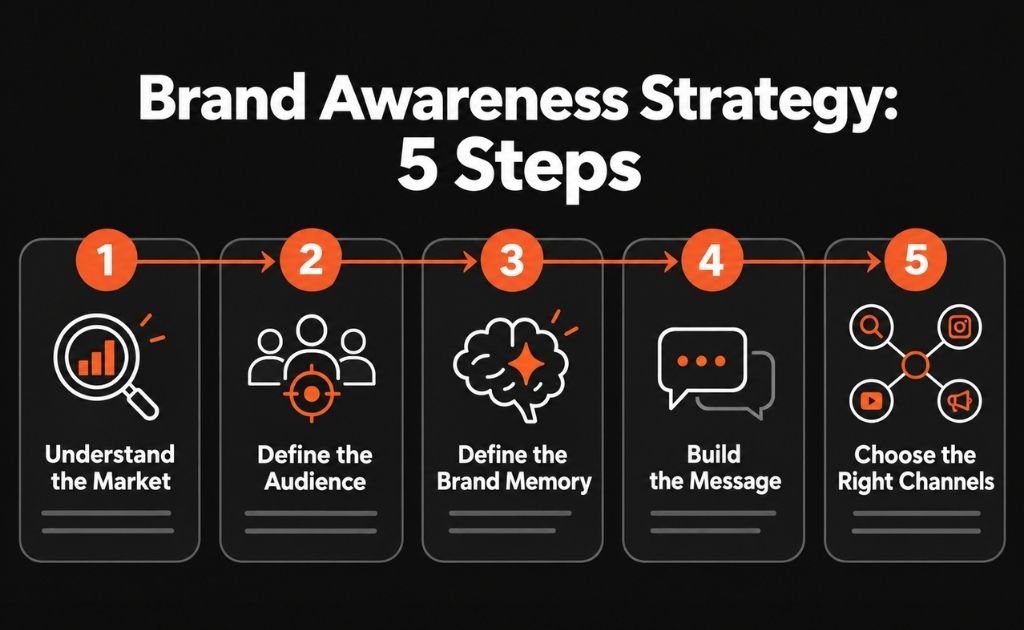
A strong brand awareness strategy begins before the first campaign is launched. I normally think it through in five steps, in this order.
1. Understand the Market
What category are you competing in? Which brands already dominate attention? What does the audience already believe, and where are the gaps?
2. Define the Audience
“Everyone who needs our product” is not an audience. Ask instead:
- Who is most valuable to the business?
- Who has the problem?
- Who influences the purchase?
- Where do they spend their attention?
- What do they already know?
The sharper the audience definition, the sharper the awareness strategy.
3. Define the Memory You Want to Create
When someone thinks about this category, what do you want them to associate with your brand? It could be premium, affordable, expert, local, fast, innovative, trustworthy or specialist. Pick one. It becomes the strategic anchor for every piece of content and every campaign.
4. Build the Message
A brand needs repetition with purpose. The audience should encounter related ideas across your website, social media, ads, content, videos and sales material. The wording can change. The core idea should not.
5. Choose the Right Channels
Do not automatically choose every platform. A brand awareness marketing strategy works when channel selection follows audience behaviour.
| Type of business | Channels that often fit |
|---|---|
| B2B business | LinkedIn, SEO, thought leadership, video |
| D2C brand | Instagram, creators, paid social, Google |
| Local service company | Google, local SEO, social media, reviews, paid search |
Brand Awareness Strategy by Business Type
The five steps stay the same. What changes is the starting point, the pace and the channels.
Brand Awareness for Startups
For a startup, the first challenge is usually “nobody knows us yet.” The answer is not always to spend heavily on ads straight away. The business may first need category education, sharper positioning, founder visibility, strong content, visual consistency and social proof, with paid exposure and search visibility layered on top.
The strategy should move people through four stages:
- “What is this?”
- “I’ve heard of this.”
- “I understand what this brand does.”
- “I would consider this brand.”
Brand Awareness for B2B Businesses
B2B awareness has a different rhythm. Someone may see your content today and contact you six months later, so B2B brands benefit from building familiarity before the buying window opens.
Useful awareness assets include industry content, executive thought leadership, technical explainers, customer case studies, webinars, LinkedIn and YouTube content, reports and newsletters. The goal is not a conversion from every impression. It is to be a name the buyer already knows when the need appears.
Brand Awareness for D2C Brands
D2C brands compete hard for attention. Customers meet them on Instagram, through creators, in Meta Ads, on Google, YouTube and marketplaces, and through reviews and recommendations.
That makes a consistent visual and verbal identity especially important. The brand should be recognisable even when the content format changes.
Brand Awareness for Local and Small Businesses
Local businesses do not need everyone in the country to know them. They need the right people in the right location to remember them, which makes local search visibility central.
A local awareness strategy can combine Google Business Profile, local SEO, social media, paid local campaigns, local content, reviews, community activity and partnerships.
For a Chennai business, the real objective is often simple: when someone in my service area needs what I offer, will they remember my name? That is a far more useful target than “more reach.”
How Do You Measure Brand Awareness?
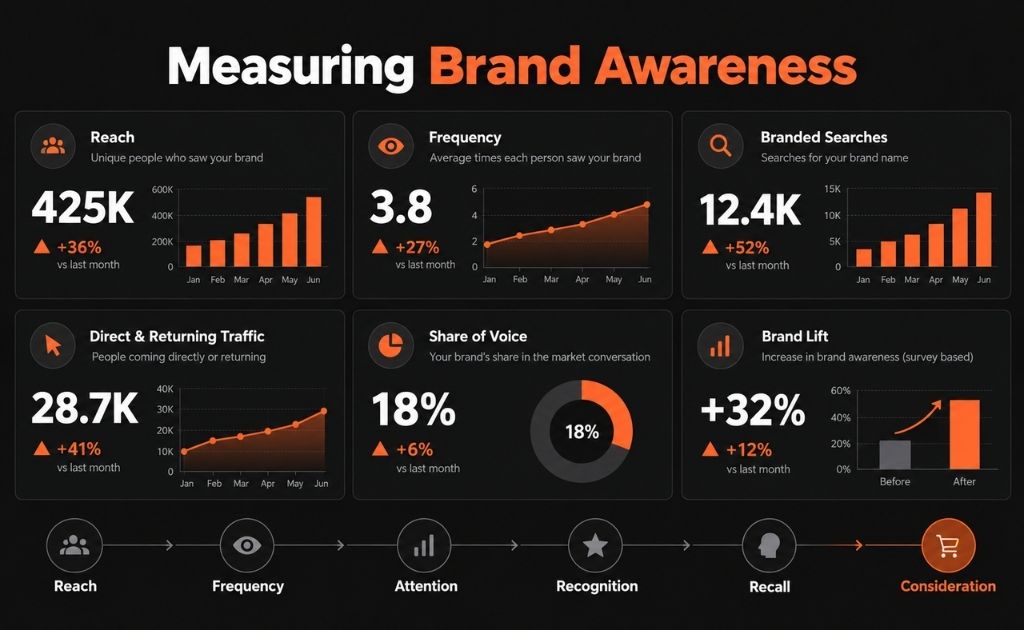
Brand awareness measurement should never rest on one number. This is where many campaigns become vague, so I look at a combination of signals instead.
| Brand awareness metric | The question it answers |
|---|---|
| Reach | How many people in the relevant audience were exposed? |
| Frequency | How often did they encounter the brand? |
| Engagement | Did they interact with the content? |
| Branded searches | Are more people searching for your brand, product, founder or branded services? |
| Direct and returning traffic | Are people coming back, or typing your address directly? |
| Social mentions and share of voice | Are people talking about the brand, and how much compared with competitors? |
| Recognition and recall surveys | Do people recognise or remember the brand when asked? |
| Brand lift and search lift | Did advertising exposure change awareness or brand searches? |
Three of these need a note.
Reach and Frequency
For video campaigns built for awareness, Google’s reach and frequency measurement reports unique people reached and how often, rather than clicks.
Direct Traffic
Read it carefully. Analytics tools classify some unattributed visits as “direct”, so a rise is a supporting signal, not proof.
Lift Studies
These are controlled experiments that compare people who saw your ads with people who did not. Google’s lift studies can measure Brand Lift (ad recall, awareness, purchase intent) and Search Lift (extra organic searches for your brand) on eligible campaigns.
The principle behind all of it: awareness measurement should connect exposure to memory and behaviour, not stop at impressions.
Impressions Are Not Brand Awareness
This is one of the easiest mistakes to make. Imagine your campaign receives 1 million impressions. It sounds impressive, until you ask a few questions.
- Did the right people see the ad?
- Was the creative memorable?
- Was the brand name clearly visible?
- Was frequency high enough to register?
- Could the audience explain what the brand does?
If the answers are no, you bought exposure. You did not build awareness.
That is why I think in terms of a chain: reach, frequency, attention, recognition, recall, consideration. The exact measurement mix depends on the business and the campaign.
Brand Awareness Expert vs Brand Strategy Consultant
These roles overlap, but the emphasis is different.
| Brand awareness expert | Brand strategy consultant |
|---|---|
| Focuses on visibility and memory | Focuses on the strategic brand foundation |
| Builds recognition and recall | Defines positioning and differentiation |
| Looks at channel exposure | Defines brand direction |
| Works on campaigns and distribution | Works on identity, messaging and positioning |
| Measures awareness signals | Measures strategic and brand outcomes |
In practice, a strong project often needs both. That is why my work connects brand strategy with digital execution rather than treating them as separate activities.
Brand Awareness Expert vs Digital Marketing Consultant
A digital marketing consultant looks across the whole digital growth system: SEO, paid advertising, social media, content, the website, analytics and conversion. Brand awareness is one strategic objective within that larger system.
My wider work as a digital marketing consultant in Chennai covers the broader picture. The awareness focus goes deeper into one question: how do we make the brand known, recognisable and remembered?
When Should You Hire a Brand Awareness Expert?
Consider expert support when one of these sounds familiar.
- Your product is good but the market does not know you. Visibility may be the bottleneck.
- People know the category but not your brand. This usually calls for stronger positioning plus repeated exposure.
- Your marketing feels disconnected. Your website, ads and social media communicate different ideas.
- You are launching a new product. A launch needs awareness before it can rely on conversion-focused tactics.
- You are entering a new market. A new audience needs to understand who you are and why you matter.
- Competitors dominate the conversation. You need to find out why they are more memorable.
- Your campaigns get views but the brand is still forgettable. That is a creative and strategic problem, not a media problem.
What Should a Brand Awareness Expert Deliver?
A professional engagement should produce something more useful than “we will increase your awareness.” Depending on the project, the deliverables can include:
| Deliverable | What it answers |
|---|---|
| Audience and market analysis | Who matters, and what do they already know? |
| Brand awareness audit | Where is the brand visible today? |
| Competitor visibility analysis | Which brands dominate attention, and why? |
| Positioning and message recommendations | What should your audience remember? |
| Channel strategy | Where should the brand appear? |
| Creative direction | How should the brand look and communicate? |
| Campaign roadmap | What happens over the next 30, 60 and 90 days? |
| Measurement framework | Which indicators show awareness is improving? |
| Optimisation | What should change based on the data? |
This is what turns expertise into something a business can actually use.
How I Approach Brand Awareness
I’m Amjad Moulana, a branding and digital marketing strategist and the founder and CEO of Notion Graffiti. I have worked across branding and digital marketing for more than a decade.
As a brand awareness strategist, I do not see the work as “run ads until people notice us.” I work through five stages.
- Understand the business. What are you selling? Who buys it? Why should anyone care?
- Understand the market. Who already owns the customer’s attention? What are competitors saying? Where are the gaps?
- Define the memory. What should someone think of when they encounter the brand?
- Build the system. Brand positioning, content, social media, SEO, paid media, video, creative and the website experience, in the mix the business needs.
- Measure. Are the right people seeing you? Are they searching for you? Are they remembering you? Are they moving closer to consideration?
That is the difference between being visible and becoming memorable, and it is the standard I would hold any brand awareness expert to.
Brand Awareness and Performance Marketing Should Work Together
Awareness and performance marketing are often treated as opposites. They do not have to be. A typical customer journey looks like this:
- They see a video.
- They notice the brand again on Instagram.
- They search for the brand on Google.
- They visit the website.
- They come back later.
- They enquire.
The first two steps are awareness. The last two are performance. Neither works well without the other, which is why I connect awareness with the wider digital system instead of running it as a separate project.
Brand Awareness and Conversion Rate Optimisation
There is one more connection. Suppose your awareness campaign works. People remember the brand and visit the website. Then they leave, because the landing page is confusing.
The awareness campaign did its job. The conversion experience did not. That is where the work of a conversion rate optimization expert comes in, and why awareness, traffic and conversion should be treated as connected stages rather than separate departments.
Common Brand Awareness Mistakes
- Trying to reach everyone. Broad reach is not necessarily useful reach.
- Changing the message constantly. People need repeated signals to form a memory.
- Treating social followers as the goal. Followers do not automatically equal recognition.
- Measuring only impressions. Exposure is not memory.
- Running ads without a creative strategy. Media spend cannot compensate for forgettable messaging.
- Ignoring SEO. People often search for a brand after discovering it elsewhere.
- Ignoring the website. The brand needs to look and sound the same after the click.
- Treating awareness as a short campaign. Memory is built by sustained, consistent exposure.
How Long Does It Take to Build Brand Awareness?
There is no universal number of days. It depends on the category, the competition, audience size, existing recognition, creative quality, budget, reach, frequency, consistency and distribution.
A new brand entering a crowded category will need far more repetition than an established company with existing recognition. The right approach is to set a baseline and measure progress against it, not to promise a fixed result in 30 days.
How to Choose a Brand Awareness Expert
Before hiring a brand awareness consultant, ask these seven questions.
- Can they explain your audience? Not only demographics, but real behaviour and buying context.
- Can they explain what should be remembered? “Increase visibility” is not an answer.
- Can they connect strategy to execution? You need someone who understands how ideas become campaigns.
- Can they explain measurement? Ask what will prove the strategy is working.
- Do they understand digital channels? Awareness today runs through search, social, content, paid media, video and websites.
- Can they show relevant thinking? Relevant experience matters more than a generic portfolio.
- Can they work with your existing team? An expert should be able to guide founders, marketing teams, agencies and execution partners.
Start With the Brand, Not the Campaign
One of the biggest mistakes businesses make is asking “what campaign should we run?” before asking “what do we want the audience to remember?”
The campaign is the delivery mechanism. The memory is the strategy. Once the memory is clear, it becomes much easier to decide what to say, what to create, where to publish, how often to appear and what to measure.
That is the point where brand awareness stops being a marketing buzzword and starts being useful.
Work With a Brand Awareness Expert in Chennai
If your business has a product, service or reputation worth building, but the market still does not recognise you strongly enough, the problem may not be the product. It may be visibility, clarity, consistency, positioning, distribution, or some combination of them.
A brand awareness strategy should identify which one is holding the business back. As a brand building expert, I connect that diagnosis with execution through Notion Graffiti’s creative and digital teams, for businesses in Chennai and beyond.
Bring your current website, your social presence, your competitors and your biggest marketing challenge. The first conversation should answer one question: what should more people know and remember about your brand, and what is stopping that from happening today?
Frequently Asked Questions
What does a brand awareness expert do?
A brand awareness expert helps businesses improve recognition, familiarity and recall through audience research, positioning, messaging, creative strategy, content, digital channels and measurement.
What is brand awareness in digital marketing?
Brand awareness in digital marketing is the process of making a brand more visible, recognisable and memorable through channels such as SEO, social media, paid advertising, content, video and websites.
What is a brand awareness strategy?
A brand awareness strategy defines the audience, the memory the brand wants to create, the message, the channels used to distribute it and the measurements used to evaluate progress.
What is the difference between brand awareness and branding?
Branding shapes what the brand is and how it should be perceived. Brand awareness is about whether the intended audience actually knows, recognises and remembers the brand.
How do you measure brand awareness?
Useful indicators include reach, frequency, branded searches, returning and direct traffic, social mentions, engagement, recognition and recall research, and brand-lift studies where a campaign is eligible.
Are impressions enough to measure brand awareness?
No. Impressions measure exposure. They do not prove that the right audience noticed, remembered or understood the brand.
Can SEO improve brand awareness?
Yes. Search visibility creates repeated exposure to a brand through informational, local, commercial and branded searches.
Can social media build brand awareness?
Yes. Social media creates repeated exposure and familiarity through consistent content, video, storytelling, creator collaborations and community engagement.
Can Google Ads be used for brand awareness?
Yes. Google Ads offers awareness-focused campaign types, reports reach and frequency for them, and can run lift studies on eligible campaigns.
How long does brand awareness take to build?
There is no fixed timeline. Results depend on the market, competition, audience, creative quality, budget, reach, frequency and consistency.
Is a brand awareness expert the same as a brand strategy consultant?
Not exactly. A brand strategy consultant focuses on positioning, identity, messaging and strategic direction. A brand awareness expert focuses on making the brand visible, recognisable and memorable in the market.
Is a brand awareness expert the same as a digital marketing consultant?
They overlap, but digital marketing consulting is broader. It can include SEO, paid advertising, social media, content, analytics and conversion, while brand awareness focuses on recognition, visibility and recall.
Can a small business benefit from a brand awareness strategy?
Yes. A small business gains most by becoming recognisable within a clearly defined local or niche market, not by trying to reach everyone.
Can brand awareness generate leads?
Brand awareness does not guarantee immediate leads. Stronger recognition and familiarity support consideration and make later conversion efforts more effective.