
Most Chennai businesses that come to me unhappy with Google Ads are not unhappy because the ads didn’t run. The ads ran. The impressions arrived. The clicks arrived. The monthly report arrived, and it was full of green arrows.
What did not arrive were customers.
That gap – between activity and outcome – is the entire job. A campaign can post a 6% click-through rate and a ₹22 cost per click and still be a quiet, steady leak, because nobody checked which search terms were actually triggering the ads, whether the enquiry form was even firing a conversion, or whether the twelve “leads” last month included nine people looking for a job, a training course, or a free version of the thing you sell.
So the useful question when you go looking for a Google Ads expert in Chennai is not “who can run ads for me.” Almost anyone can run ads. The question is: who can connect what happens inside the ad account to what happens inside your business – and show you the working?
This guide is written to help you evaluate that, whether or not you end up speaking to me.
What Does a Google Ads Expert in Chennai Actually Do?
A Google Ads expert plans, builds and continuously manages paid search campaigns so that advertising spend produces measurable business results. That means keyword and search-intent research, campaign and ad group structure, ad copy, negative keywords, landing page alignment, conversion tracking setup, bid and budget strategy, weekly search-term review, and reporting tied to leads and revenue – not just clicks.
Unpacking that a little, the work breaks into three layers that get progressively harder to fake.
Layer one – setup. Research the business, the offer and the buyer. Build the keyword set around what people type when they are ready to act, not when they are curious. Structure campaigns so budget can be controlled independently for things that behave differently. Write ads. Point them somewhere sensible.
Layer two – measurement. Install conversion tracking that actually reflects a business event. Decide which conversion actions count as primary and which are secondary. Make sure a phone call, a WhatsApp enquiry and a form submission are all visible, because in Chennai those three channels rarely behave the same way.
Layer three – the loop. Read the search terms report. Add negatives. Look at which ad groups produce enquiries that the sales team actually calls back. Feed that judgement back into bidding. Adjust. Repeat.
Most cheap Google Ads management stops at layer one, reports on layer one metrics, and never builds layer three at all. Layer three is where the money is.
Why “Running Ads” and “Managing Ads” Are Different Jobs
Here’s the chain a rupee travels down before it becomes revenue:
Targeting → relevance → ad quality → landing page → conversion → tracking → optimisation
Break any link and everything downstream is wasted. Perfect keywords pointed at a homepage that doesn’t mention the service will not convert. Beautiful ads with untracked conversions cannot be optimised, because Google’s bidding systems learn from the conversion signal you send them – send a bad signal and the algorithm gets efficiently better at buying you the wrong traffic.
That last point is worth sitting with. Modern Google Ads is heavily automated, and automation amplifies whatever you point it at. If your conversion action is “clicked the phone number” rather than “had a real conversation,” Smart Bidding will faithfully optimise toward people who tap and hang up. The expertise is no longer mostly in pulling levers. It is in deciding what the machine is allowed to learn from.
Google Ads Campaign Types: What Actually Applies to You
Not every business needs every campaign type. Anyone who proposes all of them in month one is selling scope, not strategy.
Search campaigns are the workhorse for most Chennai service businesses. Someone types a problem, you appear, they call. Highest intent, most controllable, and where I’d start for the majority of lead-generation businesses.
Performance Max runs across Search, Shopping, YouTube, Display, Discover, Gmail and Maps from one campaign. It can work very well for eCommerce with a clean product feed. It’s worth being clear-eyed about the trade: you get channel-level reporting, but you cannot switch individual channels off. Google’s own documentation is explicit that you influence allocation through assets, audience signals and conversion accuracy – not by direct control. Recent additions like campaign-level negative keyword lists, brand exclusions and up to 50 search themes per asset group have made it more manageable than it was, but it still asks for more trust than a Search campaign does.
Display is best understood as reach and remarketing, not as a lead source. Note that Google has begun migrating standalone Display campaigns into Demand Gen through 2026, so anyone still pitching “Display campaigns” as a stable, separate line item is working from an outdated playbook.
YouTube suits considered purchases where the buyer needs to see something demonstrated or trusted – education, healthcare, high-ticket services.
Shopping is for eCommerce with a product feed. If you don’t have a feed, this isn’t a conversation yet.
Remarketing re-engages people who already visited. Cheap, useful, and frequently the highest-ROAS line in the account – but only if enough people are arriving in the first place.
How a Google Ads Expert Structures a Campaign
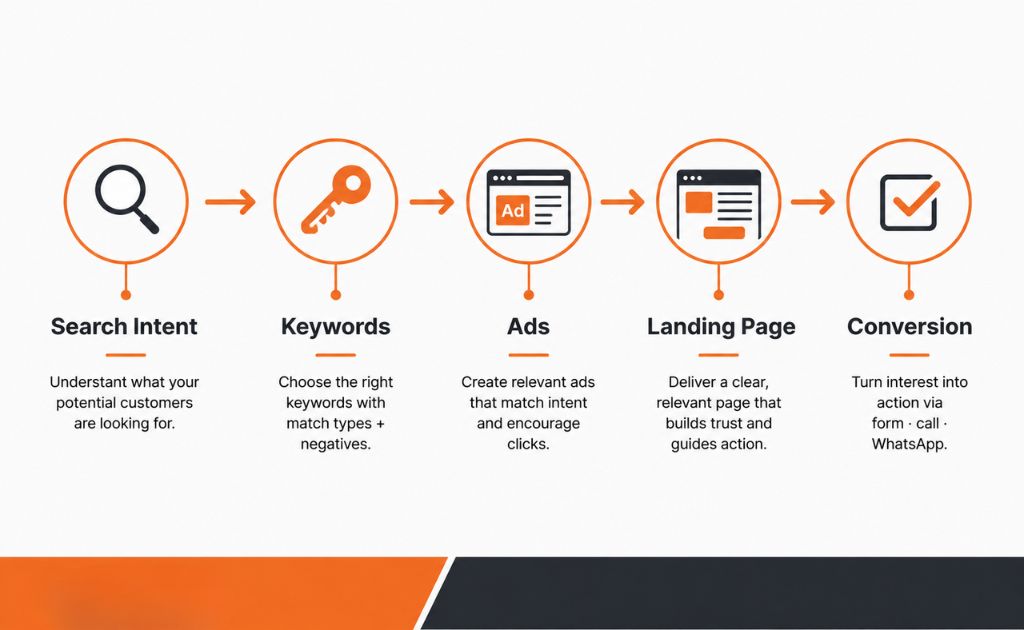
This is the process I’d expect any competent consultant to be able to walk you through without notes:
- Business goal – what a “win” is in rupees, not in impressions
- Audience and offer – who buys, and what makes them choose you over the other eleven results
- Keyword research – grouped by what the searcher wants, not by search volume
- Search-intent mapping – separating “how does X work” from “X price” from “X near me”
- Campaign structure – split by service line, margin, or geography so budget can be steered
- Ad groups – tight themes, so the ad can genuinely match the search
- Ad copy – Responsive Search Ads, up to 15 headlines and 4 descriptions, tested rather than guessed
- Negative keywords – before launch, not after the first bad month
- Landing page – matched to the ad’s promise, mobile-first, with an obvious next step
- Conversion tracking – verified as firing correctly before spend starts
- Launch – deliberately modest, to buy data cheaply
- Search-term analysis – weekly at first, and this is non-negotiable
- Optimisation – bids, budgets, negatives, ad assets, landing pages
- Reporting – leads and cost per lead, with lead quality noted
Steps 8, 10 and 12 are the ones most often skipped, and they are the three that decide whether the account leaks.
Keyword Research and Search Intent
Volume is a vanity metric. Intent is the real variable.
- Informational – “how does Google Ads work”. Rarely worth paid budget for a service business.
- Commercial – “best CRM for small business”. Worth bidding on if you can be genuinely useful.
- Transactional – “buy air conditioner online”. Ready to act.
- Local – “AC service near me”. High intent, mobile-heavy, often a phone call within minutes.
- High-intent service – “commercial pest control Chennai price”. These convert.
Google matches keywords in three ways – broad, phrase and exact – and all three are now meaning-based rather than literal string matching. Broad match in particular uses the searcher’s recent activity, your landing page content and the other keywords in the same ad group to infer intent, and Google positions Smart Bidding as the control mechanism that keeps it honest.
The practical implication: you can no longer rely on match type alone to control what you pay for. Exact match no longer means “only this exact string.” Which is precisely why the next two sections matter more than they used to.
Negative Keywords: The Cheapest Optimisation You Own
Negative keywords tell Google which searches to exclude. They are the difference between a campaign that spends ₹60,000 and produces 40 enquiries, and one that spends ₹60,000 and produces 40 enquiries plus ₹18,000 of clicks from people who were never going to buy.
There is one important asymmetry most people get wrong: negative keywords do not match close variants. Your positive keywords match by meaning; your negatives match literally. Block “free” and you have not blocked “freee” or “no cost”. Negatives need to be built and maintained deliberately.
Common exclusions when you sell a paid service: free, jobs, vacancy, salary, career, course, training, tutorial, how to, DIY, sample, internship, wholesale, and – often overlooked – competitor brand names you don’t want to pay to appear against.
But I want to be direct: there is no universal negative keyword list, and anyone handing you one on day one hasn’t looked at your business. “Course” is a waste term for a consultant and a core revenue term for a training institute. The only honest way to build the list is to read the search terms report every week and prune what you actually see, and Google Ads allows up to 10,000 negatives per campaign precisely because this is ongoing work.
Conversion Tracking: Where Most Chennai Accounts Actually Break
If I audit ten Google Ads accounts in Chennai, the most common single fault is not bad keywords. It’s tracking that is missing, duplicated, or measuring the wrong thing.
Google Ads can measure conversions from four sources: your website, your app, phone calls, and imported offline conversions from your CRM. That last one is the professional’s tool and it is almost never set up in small accounts.
For a typical Chennai lead-generation business, here’s what should be tracked and how:
| Enquiry type | How it’s tracked | Common failure |
| Form submission | Thank-you page or form-submit event via Google Tag Manager | Fires on page load, inflating conversions |
| Phone call from the ad | Call assets with a Google forwarding number and a minimum call duration | Not set up at all – calls invisible |
| Call from a number on the website | Google tag plus a website call conversion event | Tracked as a click, not a call |
| WhatsApp enquiry | Click event on the WhatsApp button, passed as a conversion | Untracked, so the highest-volume channel is invisible |
| Purchase / booking | Transaction event with value | No value passed, so ROAS can’t be calculated |
Two configuration details that separate a professional setup from a default one. First, primary versus secondary conversion actions: primary actions report in the “Conversions” column and feed bidding; secondary actions report only in “All conversions.” Set a soft signal like a WhatsApp click as primary and your bidding will chase taps instead of business. (One nuance worth knowing – actions inside a custom goal are used for bidding regardless of the primary/secondary label.) Second, enhanced conversions improve measurement accuracy by sending hashed first-party data, and there is a specific variant for lead-gen businesses that matches back to offline conversions you import.
One deprecation to flag, because it will catch anyone working from a 2023 playbook: call-only ads are being retired. New ones could no longer be created from February 2026, and existing ones stop serving in February 2027. The replacement is Responsive Search Ads with call assets. If a prospective consultant proposes call-only campaigns, that tells you when they last read the documentation.
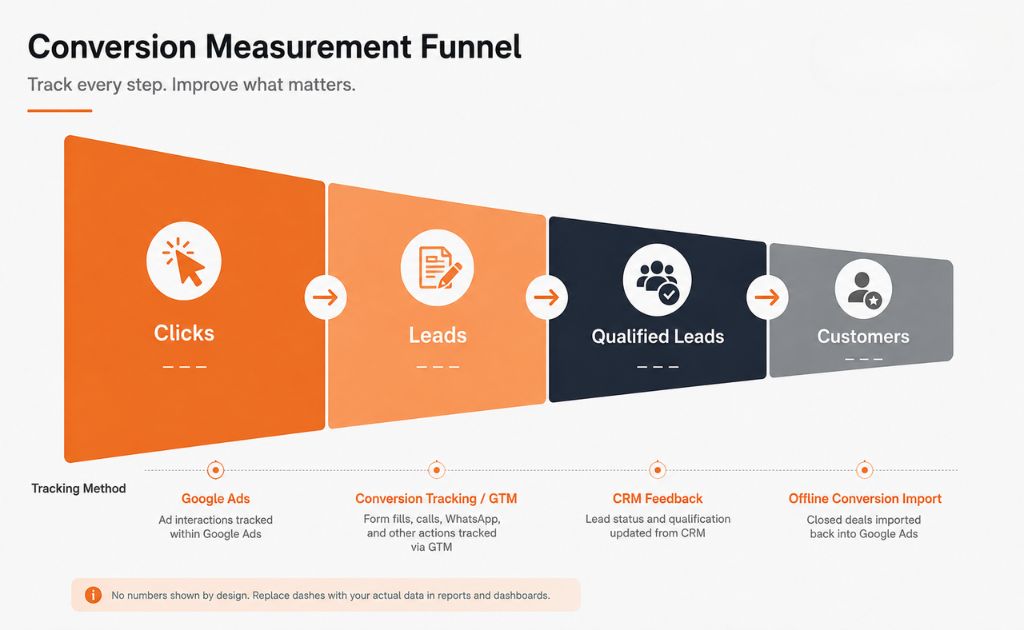
The chain you’re really building is:
Click → Conversion → Qualified lead → Customer
Most accounts measure the first two. The good ones measure all four.
How to Measure Google Ads Performance
| Metric | What it tells you | Why it matters |
| Impressions | How often your ad was shown | Demand and coverage – but on its own, it means nothing |
| CTR | How compelling the ad is to the people seeing it | Low CTR usually means keyword–ad–intent mismatch |
| CPC | What you pay per visitor | Sets your ceiling on volume for a given budget |
| Conversion rate | How well the landing page turns visitors into enquiries | Usually the fastest lever available; a page fix beats a bid fix |
| CPL | Cost per lead | The primary KPI for most service businesses |
| CPA | Cost per acquisition (a customer, not an enquiry) | The honest number for anyone with a sales process |
| Qualified leads | Enquiries sales actually wants | The metric that exposes whether cheap CPL was real |
| ROAS | Revenue per rupee of ad spend | The primary KPI for eCommerce; misleading for long sales cycles |
The right KPI depends on your business model. An eCommerce brand should be judged on ROAS. A B2B manufacturer with a 90-day cycle should be judged on qualified leads and eventually CPA – judging it on ROAS in month one produces the wrong decisions. A clinic should be judged on booked appointments. Any consultant who applies the same dashboard to all three is not thinking about your business.
Leads Versus Qualified Leads
A lead is not automatically a good lead, and lead volume is the easiest metric in Google Ads to manufacture.
Loosen the targeting, bid on broader terms, put a low-friction form on the page, and CPL will fall. It will look like a win in the report. Meanwhile the sales team is spending its mornings calling students, job-seekers, competitors doing research, and people 400 kilometres outside your service area.
A qualified lead is one that clears the filters that matter to you – intent, fit, budget, location, genuine need, workable timeline, and acceptance by your sales team. The mechanism for closing that loop is real: you mark which enquiries turned into opportunities in your CRM, import those back into Google Ads as offline conversions, and let the bidding optimise toward the enquiries that resemble your actual customers.
That loop requires the client to participate. It is also the difference between an account that gets cheaper over time and one that just gets busier. When you interview a Google Ads expert, ask specifically how they will measure lead quality. The answer will separate the professionals from the report-generators faster than any other question.
Google Ads for Chennai Businesses: What’s Genuinely Local
Some of this keyword’s competition treats “Chennai” as a word to sprinkle. A few things are actually location-specific, and they cost real money when handled badly.
Location targeting settings. This is the most expensive silent mistake I see. Google’s default location option targets people interested in your location as well as people present in it – which means a Chennai plumbing business can pay for clicks from someone in Dubai reading about Chennai. Setting targeting to presence rather than presence-or-interest is often the single highest-value change in a first audit.
Radius versus city. A service business on OMR serving a 15-km catchment should not bid across all of Chennai at the same value. Radius targeting with bid adjustments reflects how customers actually travel.
The phone and WhatsApp reality. A large share of Chennai enquiry volume is a call or a WhatsApp message, not a form. If those aren’t tracked as conversions, the account is optimising on partial data – and it will systematically under-invest in the campaigns producing your best enquiries.
Mobile experience. Most local-intent traffic is mobile. If the landing page takes six seconds to load on a mid-range Android on a mobile network, the bid strategy is not your problem.
Bilingual search behaviour. Commercial searches in Chennai are frequently a mix of English and transliterated Tamil. That’s worth reflecting in keyword research and occasionally in ad copy, rather than assuming an English-only keyword set covers the market.
Google Ads Costs in Chennai: How Pricing Actually Works
Three separate things get confused in almost every pricing conversation, so let’s separate them:
1. Ad spend – money paid to Google. This is your media budget. It is not income for your consultant.
2. Management fee – money paid to the consultant or agency for strategy, build, tracking and ongoing optimisation.
3. Additional costs – landing page design and development, creative and video, tracking implementation, CRM integration, content.
Your management fee is never your advertising budget. Anyone who quotes a single blended number without separating them is either inexperienced or hoping you won’t ask.
In the Chennai market, management is generally priced as a flat monthly retainer, a percentage of ad spend, or a hybrid (flat fee up to a spend threshold, percentage above it). Published rates from Chennai providers currently range from roughly ₹5,000 to ₹15,000+ per month for management, with percentage models typically around 10% of spend above a threshold, and freelance hourly rates on international platforms spanning a wide band.
One thing worth naming, because nobody in this market does: percentage-of-spend pricing creates a structural incentive to increase your spend. That doesn’t make it wrong – it aligns well for scaling eCommerce accounts – but you should understand the incentive you’re buying. Flat fees create the opposite bias: a temptation to under-service a growing account. Neither is inherently honest or dishonest. Knowing which one you’re in lets you ask the right questions.
What actually moves the fee: campaign complexity, monthly ad spend, number of campaigns and locations, breadth of services or SKUs, number of landing pages, tracking and CRM integration requirements, reporting depth, and optimisation frequency.
How Long Does Google Ads Take to Work?
A realistic sequence, assuming a reasonably competitive Chennai service vertical:
- Week 1 – audit, tracking build and verification, keyword and structure work. Little or no spend.
- Weeks 2–4 – launch, daily search-term pruning, early negative keyword building, first ad copy tests. Data collection, not judgement.
- Days 30–60 – meaningful search-term discipline, landing page fixes, bid strategy tuning once there is enough conversion data for automation to learn from.
- Days 60–90 – the first honest read on cost per qualified lead, and the point at which scaling decisions become sensible.
I won’t give you a guaranteed cost per lead, ROAS, or lead volume, and you should be suspicious of anyone who does. Performance depends on your market, competition, offer, budget, landing page, tracking quality, search demand and your own sales process – several of which sit outside the ad account entirely.
When Google Ads Is the Wrong Choice
No other page on this topic will tell you this, so I will. Google Ads is probably not right for you yet if:
- Nobody is searching for what you sell. Google Ads captures existing demand; it does not create it. A genuinely new category is usually a social or content problem first.
- You have no landing page and no budget to build one. Sending paid traffic to a homepage wastes most of it.
- Nobody answers the phone during business hours. For local services, this is a bigger revenue leak than any bidding mistake.
- Your budget is very small in a high-CPC vertical. In categories where clicks run into the hundreds of rupees, a few thousand a month buys too few clicks to learn anything.
- You cannot commit to a feedback loop. If nobody will tell me which leads were rubbish, I’m optimising blind.
Being told this at the start is worth more than being sold a campaign.
Common Google Ads Mistakes
- Sending all traffic to the homepage instead of a matched landing page
- No conversion tracking, or tracking that fires on page load
- No negative keywords, or a list built once and never touched
- Never reading the search terms report
- Optimising for clicks and CTR instead of qualified enquiries
- Location targeting left on presence-or-interest
- Phone and WhatsApp enquiries untracked
- Using Performance Max as a default before Search has been proven
- Mixing brand and non-brand traffic in one campaign, so brand searches flatter the numbers
- Changing bids and budgets daily, so automation never stabilises
- No lead-quality feedback from sales back into the account
- Ignoring mobile page speed and mobile form experience
- Spending without a defined KPI, so “good” is whatever the report says
How to Choose a Google Ads Expert in Chennai
A short checklist to work through:
- Real campaign experience in accounts of similar size and model to yours
- Relevant industry exposure – or at least honesty about the learning curve
- Demonstrable technical knowledge of negative keywords, search terms, match types and campaign types
- Conversion tracking capability – can they set it up themselves, or do they need your developer?
- Lead-quality measurement – do they have a method, or just the phrase?
- Landing page understanding – do they treat the page as part of the campaign?
- Reporting that shows leads and cost per lead, not just impressions
- Account ownership – the Google Ads account must be in your name, with you as admin
- Data ownership – you keep the history if you part ways
- Transparency on the fee-versus-spend split
- Optimisation frequency – stated, not vague
- Communication – one point of contact who understands your business
- Case studies or references where they exist
Questions to Ask Before You Hire
- How do you define a successful campaign for a business like mine?
- How exactly will you track conversions, including calls and WhatsApp enquiries?
- How will you identify and eliminate poor-quality searches?
- How do you build and maintain negative keywords?
- Which campaign types would you recommend for me, and why not the others?
- How will you measure qualified leads, not just lead volume?
- Who owns the Google Ads account, and what happens to it if we stop working together?
- Is your management fee separate from ad spend, and is it flat or a percentage?
- How often will campaigns be reviewed and optimised?
- What will your monthly report contain?
- Can you show relevant work or explain a campaign you turned around?
- What happens if the campaign underperforms in the first 90 days?
Red Flags
Walk away from guaranteed rankings, guaranteed lead counts, guaranteed ROAS, and suspiciously specific CPL promises made before anyone has seen your account. Also treat these as warnings: no conversion tracking discussion, no willingness to give you account access, reports without cost per lead, no explanation of strategy, optimising purely for clicks, no mention of landing pages, no interest in your lead quality, and long contracts with vague deliverables.
Google Ads Consultant vs Agency: Which Fits You?
A consultant typically gives you direct access to the person doing the work, personalised strategy, flexible engagement terms and faster decisions. The constraint is capacity – one person cannot simultaneously build landing pages, produce creative and manage six channels.
An agency brings an execution team: design, content, development, SEO, analytics, multiple specialists and the ability to scale. The constraint is that the senior person you met in the pitch may not be the person in your account on a Tuesday.
Neither is universally better. If your need is focused – one channel, clear offer, existing landing page – a consultant is usually better value. If Google Ads is one part of a broader push that also needs a website, creative and organic search, an agency structure will serve you better.
Why You Might Consider Working With Me
I’ll be straightforward about what I can and cannot evidence, because this article has spent 2,000 words arguing that you should demand exactly that.
What’s verifiable. I’m based in Chennai and I run Notion Graffiti, a Chennai digital marketing agency, as Founder & CEO. My work spans performance marketing, SEO, brand strategy, social media and web development – which means when a Google Ads campaign underperforms, I’m not limited to changing bids. I can look at the landing page, the offer, the organic search picture and the wider funnel, because those are things my team builds. Our published case studies include lead-generation work measured in qualified enquiries rather than raw lead volume – which is the distinction this entire article has been about.
Where my public paid-search proof currently sits. Most of my published paid-media work to date is on Meta – see my Meta Ads work in Chennai. I am actively documenting Google Ads campaign work for publication, and I would rather tell you that than show you a “3X ROI” claim with nothing behind it. If you want Google Ads-specific evidence before committing, ask me on a call and I’ll walk you through account work directly.
Why the broader perspective helps here. Google Ads rarely fails inside the ad account. It fails at the landing page, at the offer, at the tracking, or at the point where a lead reaches a sales process that isn’t ready for it. Someone who only touches the ad account can only fix a fraction of that chain.
Let’s Look at Your Account
If you’re already running Google Ads, the fastest useful thing I can do is look at your search terms report and your conversion setup. That usually tells me within twenty minutes where the budget is going and whether the numbers in your report mean anything.
Come to the conversation with: your industry and target audience, the areas you serve, what you’re currently running, your rough monthly ad budget, your main conversion goal, your existing landing page, and the specific problem you’re trying to solve.
– no fixed promises, just an honest read on whether Google Ads is the right spend for your business right now, and what it would realistically take.
If you’d rather start broader than a single channel, my digital marketing consulting in Chennai page covers how paid search fits alongside SEO, content and brand.
Frequently Asked Questions
What does a Google Ads expert in Chennai do?
They plan, build and manage paid search campaigns end to end – keyword and intent research, campaign structure, ad copy, negative keywords, conversion tracking, bid and budget strategy, weekly search-term review, and reporting tied to leads and revenue rather than clicks.
How much does Google Ads management cost in Chennai?
Management fees are separate from ad spend. Chennai providers commonly charge a flat monthly retainer, a percentage of ad spend (often around 10% above a threshold), or a hybrid. Published market rates start around ₹5,000/month and rise with campaign complexity, spend level and tracking requirements.
What’s the difference between a Google Ads expert and a PPC agency?
A consultant gives you direct access to the person doing the work and more flexible terms. An agency gives you a broader execution team – design, development, content, multiple specialists – and more capacity to scale. The right choice depends on how much of the funnel you need built.
How long does it take for Google Ads to work?
Expect roughly two to four weeks of setup and data collection, meaningful optimisation between days 30 and 60, and a reliable read on cost per qualified lead around day 60 to 90. Anyone promising results in week one is guessing.
How much should I spend on Google Ads?
Enough to buy meaningful data in your vertical. Work backwards from typical cost per click in your category and how many clicks you need to generate a statistically useful number of conversions. In high-CPC categories, a very small budget buys too few clicks to learn anything.
How are Google Ads conversions tracked?
Through website conversions, phone call conversions, app conversions and imported offline conversions from your CRM – usually implemented via the Google tag and Google Tag Manager, with key events optionally imported from Google Analytics 4. Setting the right actions as primary is what determines how bidding behaves.
Can WhatsApp enquiries be tracked as Google Ads conversions?
Yes. A click on a WhatsApp button can be captured as an event through Google Tag Manager and passed to Google Ads as a conversion. It’s frequently missed, and for many Chennai businesses it’s the highest-volume enquiry channel – leaving it untracked means optimising on partial data.
What is a good cost per lead for Google Ads?
There is no universal benchmark. A good CPL is one that works against your close rate and average order value. A ₹400 lead is expensive for a ₹2,000 product and very cheap for a ₹4,00,000 one. Always evaluate cost per qualified lead alongside it.
Should I use Search campaigns or Performance Max?
For most Chennai lead-generation businesses, prove Search first – it’s higher intent and far more controllable. Performance Max suits eCommerce with a clean product feed, or accounts with reliable conversion data already in place. Running PMax before tracking is trustworthy tends to produce confident-looking, unreliable results.
Do I need a landing page for Google Ads?
In almost every case, yes. Sending paid traffic to a general homepage forces the visitor to re-navigate to what your ad promised, and conversion rate drops sharply. A matched, mobile-fast landing page with one clear action is usually the cheapest performance improvement available.
How can I reduce wasted Google Ads spend?
Read the search terms report weekly and add negatives. Set location targeting to presence rather than presence-or-interest. Verify conversion tracking is measuring real business events. Separate brand and non-brand campaigns. And make sure your bidding is optimising toward qualified leads, not soft signals.
How can I contact Amjad Moulana about Google Ads?
Reach out through the contact section on my site with your industry, service areas, current campaign activity and monthly budget, and we can look at whether Google Ads is the right investment for your business right now.



Pingback: AI Marketing Consultant in Chennai | Strategy & Automation
Pingback: Sales Funnel Consultant in Chennai: How to Boost Sales