
Most marketing teams I meet are not short of AI tools. They have one for writing, one for research, one for ad copy, one for reports, and a few more that someone signed up for after a webinar. What they are short of is a system: an agreed way of using AI that makes the marketing measurably better and that the team actually follows.
That gap is what an AI marketing consultant works on. The job is to understand the business, find the places where AI gives real leverage, design workflows the team can run, put human checks where mistakes would be costly, and tie all of it to numbers the business already cares about.
I’m Amjad Moulana, and I work as an AI marketing consultant in Chennai alongside my wider strategy work. My rule for every engagement is the same: business problem first, AI second, tools third.
This page covers where AI helps in marketing, where it doesn’t, what consulting costs, and how to judge whether you need a consultant at all.
Table of Contents
What Is an AI Marketing Consultant?
An AI marketing consultant helps a business decide where artificial intelligence can improve its marketing, then turns that decision into a repeatable workflow with clear ownership, human review and a measurable result. The work can touch strategy, customer research, content, SEO, paid media, social media, lead management, reporting and team training.
The list matters less than the diagnosis. A business often arrives asking for an AI content tool. When we map the workflow, the real bottleneck turns out to be somewhere else: research that takes days, leads that wait hours for a reply, reports assembled by hand every Monday, or customer data spread across three systems that never meet.
Recommending technology before finding that bottleneck is how companies end up with ten subscriptions and no change in results.
AI Marketing Consultant vs Digital Marketing Consultant
The two roles overlap, but they answer different questions.
| Area | Digital marketing consultant | AI digital marketing consultant |
| Core question | Which channels and messages should we use? | Which parts of this system can AI make faster or smarter without lowering quality? |
| SEO | Strategy, audits, content planning | AI-assisted research, clustering and briefs |
| Paid media | Campaign structure, budgets, creative | Steering automated bidding, analysing results at scale |
| Content | Topics, formats, editorial standards | Research, production and repurposing workflows |
| Leads | Generation and funnel design | Qualification, routing and follow-up workflows |
| Reporting | KPIs and interpretation | Automated consolidation and first-draft insight |
My work as a digital marketing consultant in Chennai covers the whole growth system. AI consulting adds a layer on top: redesigning specific parts of that system around automation, data and AI-assisted decisions.
AI Marketing Is More Than ChatGPT
Using a generative AI tool to write a caption is one small use case. The bigger gains come from connecting steps that are currently done by hand:
- Customer data: segmentation, then content variation, campaign delivery, response analysis and optimisation
- Search data: keyword research, then content planning, draft assistance, human review, publishing and performance analysis
- Lead enquiry: qualification, then routing, follow-up, CRM update and sales notification
The technology supports each chain. Strategy decides why the chain exists and what it should achieve.
What Can an AI Marketing Consultant Help With?
These are the nine areas where I see AI produce results most often. No business needs all nine at once. The right starting point is usually one or two.
1. AI Marketing Strategy
Before any tool is chosen, an AI marketing strategy should answer seven questions: what is the business objective, where is the bottleneck, what data is available, what can the team handle, which workflow changes, what outcome is expected, and which metric proves it.
The output is a short roadmap with priorities and owners. A list of 25 tools to try is a shopping list, and it leaves the hard decisions unmade.
2. AI Marketing Automation
Automation works best where the task is repetitive and the rules are clear. Typical candidates are lead categorisation and routing, CRM updates, report generation, campaign alerts, content repurposing, meeting summaries and follow-up reminders.
When I work as an AI marketing automation consultant, I map the AI marketing workflow on paper first: the trigger, the input, the decision, the output and the person who checks it. If a workflow cannot be drawn clearly, it is not ready to be automated.
3. AI for Content Marketing
AI is useful across content operations: topic research, briefs, outlines, repurposing a long piece into shorter formats, summarising, translation support and content gap analysis.
What it cannot supply is the first-hand experience and point of view that make content worth reading. Google’s guidance, covered further down, rewards exactly that, and treats mass-produced pages made to manipulate rankings as spam.
The workflow I recommend is AI-assisted research, human insight, original writing, editorial review, then measurement. “Prompt, publish, repeat” produces volume and very little else.
4. AI for SEO
AI speeds up the heavy parts of SEO: keyword clustering, search-intent analysis, content gap discovery, competitor and SERP pattern research, briefs, internal-link suggestions, classifying large sets of URLs and spotting anomalies in performance data.
Judgement stays human. A tool can tell you competitors have 50 pages on a subject. It cannot tell you which five your business should write first, or whether the topic deserves a page at all. That prioritisation is the core of my work as an SEO consultant in Chennai, and AI sits underneath it as a faster research layer.
5. AI for Google Ads and Paid Marketing
Google Ads is already an AI product. Google Smart Bidding sets a bid for every auction using signals no human team could process. Google Demand Gen campaigns use AI to place creative across YouTube, Discover, Gmail, Maps and the Display Network. Google also publishes guidance on steering AI-powered Search ads.
So the decision is rarely whether to use AI in paid media. The decisions that matter are these:
- What is the campaign optimising toward?
- Is conversion tracking reliable?
- Is the data clean enough for the system to learn from?
- What do people still review every week?
Automation amplifies whatever signal it is given. A poor conversion setup makes the system very efficient at buying the wrong traffic. I cover the mechanics on my Google Ads expert in Chennai page.
6. AI for Social Media Marketing
AI takes repetitive work out of social media: content ideation, topic clustering, caption variations, repurposing, content calendars, comment analysis and performance summaries.
Social is still a human channel. Brand personality, cultural context, humour and timing decide whether a post lands, and a technically correct caption can sound nothing like you. Use AI to give the team more capacity and keep a person responsible for the voice. A defined voice makes this far easier, which is where brand strategy comes in.
7. AI for Lead Generation
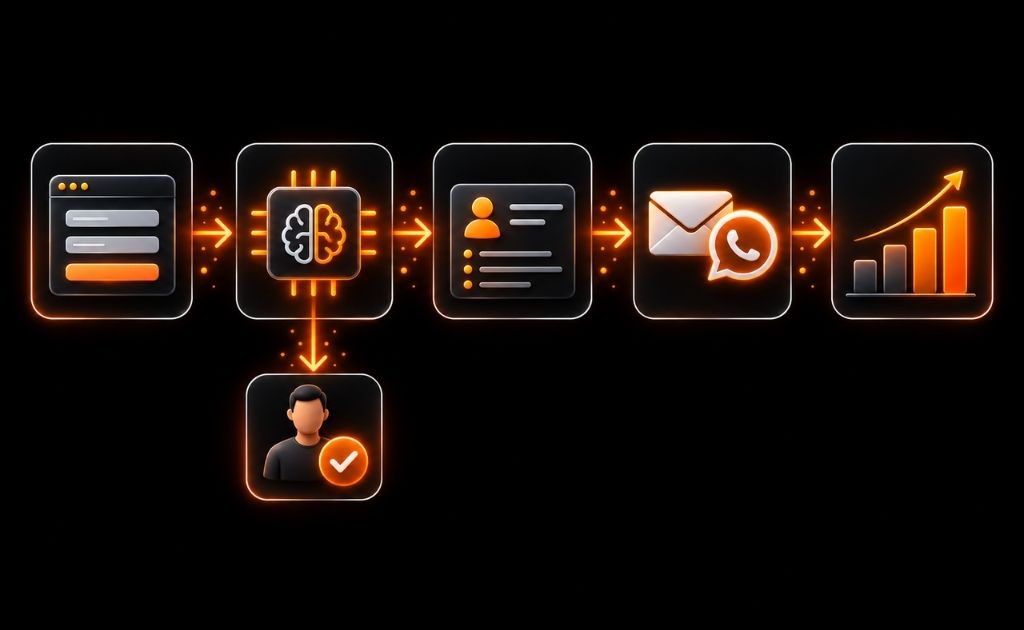
Lead handling is one of the strongest areas for practical AI adoption. A typical workflow runs like this:
- Enquiry arrives from a form, call, WhatsApp or ad
- AI-assisted classification sorts it by type and intent
- The lead is enriched with whatever data is available
- It is given a priority score
- The CRM is updated automatically
- Sales is notified
- A personalised follow-up goes out, reviewed where needed
The exact design depends on your CRM, data quality and sales process. The aim is faster, better-sorted lead movement. A company with 1,000 poorly qualified enquiries rarely needs more leads. It needs better qualification and a quicker response.
8. AI for Customer Segmentation and Personalisation
Not every customer should receive the same message. AI can group customers by behaviour, purchase history, engagement, geography, product interest, lifecycle stage and lead source, and those groups can then shape content, offers, email, advertising, remarketing and sales follow-up.
The segmentation logic still has to make business sense. Fifty segments that nobody can act on are worth less than five that the team actually uses.
9. AI for Marketing Analytics and Reporting
Marketing teams spend too many hours producing reports. AI can consolidate data, summarise performance, detect anomalies, compare periods and write first-draft commentary.
The value shows up when the report answers four questions: what changed, why it might have changed, what to investigate, and what to do next. That is more useful than 20 automated pages of numbers.

When a report shows traffic rising while enquiries stay flat, the next step is usually conversion rate optimisation before any further automation.
AI Search, AI Overviews and the AEO/GEO Question
Search itself is changing. Google now answers many queries through AI Overviews and AI Mode, and in 2026 it published official guidance on optimising for generative AI features in Search.
Its position is clear. These features are built on the same core ranking and quality systems as the rest of Search, so established SEO practice still applies. On “AEO” and “GEO”, Google says that optimising for generative AI search is, from its perspective, still SEO.
The same guide lists popular tactics you can ignore for Google Search: llms.txt files, “chunking” content into tiny pieces, rewriting pages just for AI systems and chasing inauthentic mentions. Structured data is not required for AI features either, though it remains useful for rich results.
What does matter is familiar:
- Content with a first-hand viewpoint that goes beyond common knowledge
- Pages that are crawlable, indexable and easy to use
- Clear topical authority, built over time
- Direct answers to the questions people actually ask
- Accurate business details across Google’s own profiles
The questions worth asking have widened. Beyond “how do I rank for this keyword?”, ask whether search systems can understand what your brand does and for whom, and whether your page says something that is not already everywhere. This is where AI marketing, SEO and content strategy now overlap.
What Should You Automate With AI?
Not every marketing task is a good automation candidate. I use four questions to sort them:
- Is the task repetitive? If yes, AI can probably help.
- Is the input reasonably structured? Clean inputs give predictable outputs.
- Is the outcome measurable? If you cannot measure it, you cannot tell whether AI improved it.
- Could a mistake damage the brand or a customer relationship? If yes, add stronger controls before anything goes live.
The short version: automate the repetitive, assist the analytical, review the sensitive, and keep strategy human.
What Should Stay Human?
AI can inform a decision without owning it. Keep people firmly in charge of:
- Brand positioning and strategic direction
- Sensitive customer communication
- Final creative approval
- Claims and factual accuracy
- Major budget allocation
- Legal and compliance decisions
- High-value customer relationships
Guardrails Every AI Workflow Needs
AI introduces factual, brand and privacy risks, so each workflow I design includes the same controls:
- Human review before anything customer-facing is published or sent
- Data boundaries that spell out what must never be entered into an external AI tool
- Source verification for every fact, figure and claim
- Brand voice rules the system is instructed with and checked against
- Access control over who can change prompts, automations and connected accounts
- Monitoring and escalation so someone notices when output quality drops, and knows who to tell
AI Marketing Readiness: Are You Ready?
AI multiplies what is already there, including the problems. Check the foundation first.
| Area | Question to answer |
| Business objective | Which metric are you trying to improve? |
| Data | Is customer and campaign data accessible and reasonably clean? |
| Tracking | Can you measure the outcomes that matter? |
| Processes | Are your marketing workflows written down? |
| Tools | Which platforms do you already pay for? |
| Team | Who will run the new workflow day to day? |
| Governance | What needs human approval? |
| Security | What information must stay out of external AI systems? |
If most of these have no answer yet, another AI subscription will not help. Fixing the foundation will.
AI Marketing Use Cases by Business Type
The right first project depends on the business model. These are the starting points I would look at.
| Business | Good first use cases | What to watch |
| Startups | Market and competitor research, content production, lead qualification, CRM workflows | Building a complicated AI stack before the basic marketing process is proven |
| B2B companies | Account research, lead qualification, sales enablement, proposal preparation, CRM hygiene, LinkedIn content | Technical accuracy and trust, which need strong human review |
| D2C and eCommerce | Product content, customer segmentation, personalised messaging, creative variations, abandoned-cart flows, review analysis | Adding AI because competitors talk about it, with no link to the customer journey |
| Local businesses | Enquiry classification, lead follow-up, review analysis, FAQs, appointment reminders, WhatsApp workflow support | Over-building; a small workflow that saves an hour a day is a good result |
For a small or local business, the best use case may look modest next to an enterprise programme. That is fine. Useful beats impressive.
AI Marketing Consultant vs Agency vs In-House Team
| Option | Best for | Trade-off |
| AI marketing consultant | Diagnosis, strategy, workflow design, prioritising use cases, guiding an existing team | Limited execution capacity unless paired with a team |
| AI marketing agency | Building and operating systems, larger programmes, scaling production | You may depend on the agency to run what it builds |
| In-house team | Daily operation, deep product knowledge, long-term ownership | Needs time, training and someone senior enough to set direction |
The label matters less than the engagement. Ask four things before you sign anything: what problem will you solve, what will you build, what will we own afterwards, and how will success be measured?
How Much Does an AI Marketing Consultant Cost?
There is no meaningful single market rate, and I would be wary of anyone who quotes one before understanding your situation. AI marketing consultant pricing depends on what you are buying:
- A one-time AI marketing audit or readiness assessment
- A strategy workshop
- A roadmap with prioritised use cases
- Workflow design and implementation
- CRM, campaign or reporting integration
- Team training
- Ongoing advisory
A one-day workshop and a six-month implementation should not be priced on the same model. A sound quotation reflects scope, complexity, systems involved and the support you need afterwards. The number of AI tools included tells you nothing.
What Should an AI Marketing Consultant Deliver?
Depending on scope, expect some or all of these:
- AI marketing audit: what works today and where AI could help
- Opportunity map: use cases ranked by value and effort
- Workflow blueprint: how each process changes, step by step
- Tool recommendation: only the technology the workflow needs
- Prompt and context framework: how the system is instructed, including brand voice
- Human review rules: where approval stays mandatory
- Implementation roadmap: what gets built first, second and third
- Measurement framework: the business metric each workflow should move
- Team training: so the workflow survives after the consultant leaves
How to Choose an AI Marketing Consultant
Knowing AI tools is the easy part. An AI marketing expert worth hiring will show these signs:
- They ask about your business and bottlenecks before mentioning any tool
- They understand marketing as well as they understand AI
- They can draw the workflow they propose to change
- They define human checkpoints without being asked
- They agree a baseline and a success metric before work starts
- They tell you which of your ideas are not worth automating
Be careful with guaranteed results, promised time savings quoted as a percentage before any audit, and proposals built around a tool the consultant resells.
How I Approach AI Marketing Consulting
I’m Amjad Moulana, a branding and digital marketing strategist with over a decade of experience, and the founder and CEO of Notion Graffiti, a marketing agency in Chennai.
My background is marketing, not machine learning engineering, and I think that is the right way round for this work. I come to AI as a marketing strategist who has to make campaigns, content and lead systems perform, so I judge every AI idea by whether it improves one of those.
I don’t begin with the tool. I start with the bottleneck:
- If content takes too long to produce, I look at the content workflow
- If reporting eats hours every week, I look at the reporting workflow
- If leads go cold between enquiry and sales, I look at the lead workflow
- If the team is trying ten AI tools and using none consistently, I look at the operating model
The sequence is always the same: understand, audit, prioritise, design, implement, measure, refine.
Speed alone is not the goal, because faster bad work is still bad work. The test I apply is whether AI helps the team make better decisions, produce better work and spend less time on repetition. Sometimes the answer is yes. Sometimes it is “not yet”, and a good AI marketing consultant should be willing to say both.
A Practical 30-Day AI Marketing Roadmap
Trying to transform a whole marketing department in a week fails. A first month can realistically look like this.
| Week | Focus | What gets done |
| 1 | Audit | Review current workflows, tools, data, reporting, content process and lead process. Record baselines. |
| 2 | Prioritise | Choose one to three high-value use cases. Park the rest. |
| 3 | Build | Design the workflow: inputs, prompts and context, tools, human checkpoints, outputs. |
| 4 | Measure | Compare against the baseline, then decide what deserves expansion. |
How to Measure AI Marketing ROI
Counting AI-generated output is the most common mistake. More posts, more emails and more reports prove activity. They do not prove a return.
Measure what the business would notice instead:
- Time saved on a named task, in hours per week
- Quality, through error rates, revision rounds or editorial acceptance
- Speed, such as time from enquiry to first response
- Commercial results: cost per qualified lead, conversion rate, CAC, ROAS or pipeline
All of these need a baseline taken before the workflow changes. Without one, any improvement is a guess.
Who Should Hire an AI Marketing Consultant?
You are probably ready if several of these sound familiar:
- Your team uses AI inconsistently, each person with a private workflow
- You pay for more AI tools than anyone can name
- Output has gone up while quality has gone down
- Reporting takes more time than acting on the reports
- Leads are not followed up consistently
- You are building a new marketing system and want AI designed in from the start
- Leadership wants an AI roadmap grounded in business decisions
Who Should Wait?
Sometimes the best advice is to fix the basics first. AI consulting is premature if your tracking is broken, your positioning is unclear, your CRM data is unreliable, your marketing process is undocumented or nobody owns the workflow. AI cannot repair a weak foundation, and the money is better spent on marketing fundamentals.
Frequently Asked Questions
What does an AI marketing consultant do?
An AI marketing consultant identifies where AI can improve a company’s marketing strategy, content, campaigns, lead handling and reporting, then designs the workflow, the human checks and the measurement needed to make it work.
How is an AI marketing consultant different from a digital marketing consultant?
A digital marketing consultant works across the whole digital growth system. An AI marketing consultant focuses on how AI can improve parts of that system through automation, analysis, content workflows and decision support.
Is AI marketing just using ChatGPT?
No. Generative AI tools are one part of it. Wider use cases include workflow automation, customer segmentation, reporting, campaign optimisation, lead management and AI-supported search and content processes.
Can AI replace marketers or an SEO consultant?
No. AI speeds up research, drafting and analysis. It does not replace business judgement, prioritisation, brand understanding or responsibility for the strategy and its results.
Does AI-generated content rank on Google?
Google’s guidance focuses on whether content is useful, unique and people-first, whatever tools helped produce it. Content mass-produced mainly to manipulate rankings falls under its spam policies.
Can AI be used for Google Ads?
Yes. Google Ads already uses AI for bidding, keyword matching and creative. Results still depend on reliable conversion tracking, sensible goals and regular human review.
Is AI marketing useful for small and local businesses?
Yes. Small businesses can use AI for enquiry handling, follow-up, review analysis, content assistance and reporting. Start with one workflow that saves time every week.
How much does AI marketing consulting cost?
There is no standard fee. Cost depends on whether you need an audit, a workshop, a roadmap, implementation, training or ongoing advisory, and on how many systems are involved.
How do I choose an AI marketing consultant?
Look for someone who understands marketing as well as AI, starts with your business problem, can explain the workflow being changed, defines human checkpoints and measures outcomes against a baseline.
What is an AI marketing roadmap?
It is a prioritised plan showing where AI will be introduced, what will be built, who owns it, what human oversight applies and how success will be measured.
Not Sure Where AI Fits Into Your Marketing?
You do not need another list of AI tools. You need to know what to automate, what to improve, what to leave human and what will move the business forward.
If you are looking for an AI marketing consultant in Chennai, bring your current marketing workflow to a 1:1 AI marketing consultation and we will work out where to start.