

Plenty of businesses are busy with marketing and still not growing. There is an SEO retainer, a Google Ads budget, a social media calendar, maybe a new website. Reports arrive every month showing more traffic, more impressions and more followers. Yet when the owner asks the only question that matters – which of this is bringing in customers we actually make money on? – nobody has a clear answer.
That gap between marketing activity and business growth is the problem a growth marketing consultant is hired to solve. The role is not about running more channels. It is about finding the one or two things that are genuinely limiting growth, fixing those first, and proving the improvement with numbers the business trusts.
This guide explains what the role involves, how it differs from digital and performance marketing, how a consultant goes about diagnosing a business, and how to decide whether you need one – or whether a channel specialist or an agency would serve you better. I am a growth marketing consultant in Chennai and the founder of a marketing agency, so I will be open about where consulting ends and execution begins.
Table of Contents
What a Growth Marketing Consultant Actually Does
The simplest description: a growth marketing consultant looks at the whole path from stranger to paying customer to repeat customer, identifies where that path is losing the most value, and sets up a disciplined process to improve it.
In practice, the work looks like this:
- Auditing the current journey. How do people find you, what happens when they land, how many enquire or buy, how many come back? Where is the data reliable and where is it guesswork?
- Finding the bottleneck. A business that doubles its traffic while its enquiry-to-sale rate is 3% has not solved its problem. The consultant’s job is to work out which stage is actually constraining growth.
- Understanding who is arriving. Lead volume means little if the leads are the wrong size, the wrong location or the wrong budget. Audience quality is examined alongside audience quantity.
- Prioritising. Out of twenty possible initiatives, which three are worth doing this quarter, given their likely impact, the confidence behind them and what they cost?
- Turning ideas into testable hypotheses with a defined success measure and a time window.
- Measuring consistently and interpreting the results honestly, including when the answer is “inconclusive”.
- Deciding what to scale, change or stop, then starting the cycle again.
Notice what is missing from that list: managing every channel. A growth consultant may well advise on SEO, paid media or email, but the distinctive contribution is deciding which problem to address first, why it matters, and how the team will know it has improved.
It is also worth saying plainly that marketing is not always the constraint. Pricing, product fit, sales follow-up, delivery quality and customer service all shape growth. A good consultant will tell you when the leak is outside marketing rather than pretend a new campaign will fix it.
How Growth Marketing Differs From Digital and Performance Marketing
These terms overlap, and anyone who tells you they are entirely separate professions is overselling the distinction. The difference is one of focus.
Digital marketing is organised around channels. A digital marketing consultant typically helps you choose, set up and coordinate SEO, paid ads, content, social and your website so they work together. The unit of work is the channel, and the question is “how do we make each channel perform well?”
Performance marketing is organised around paid acquisition and cost efficiency – cost per lead, cost per acquisition, return on ad spend. A performance marketing consultant lives inside Google Ads, Meta Ads and the tracking behind them. The question is “how do we buy customers more cheaply?”
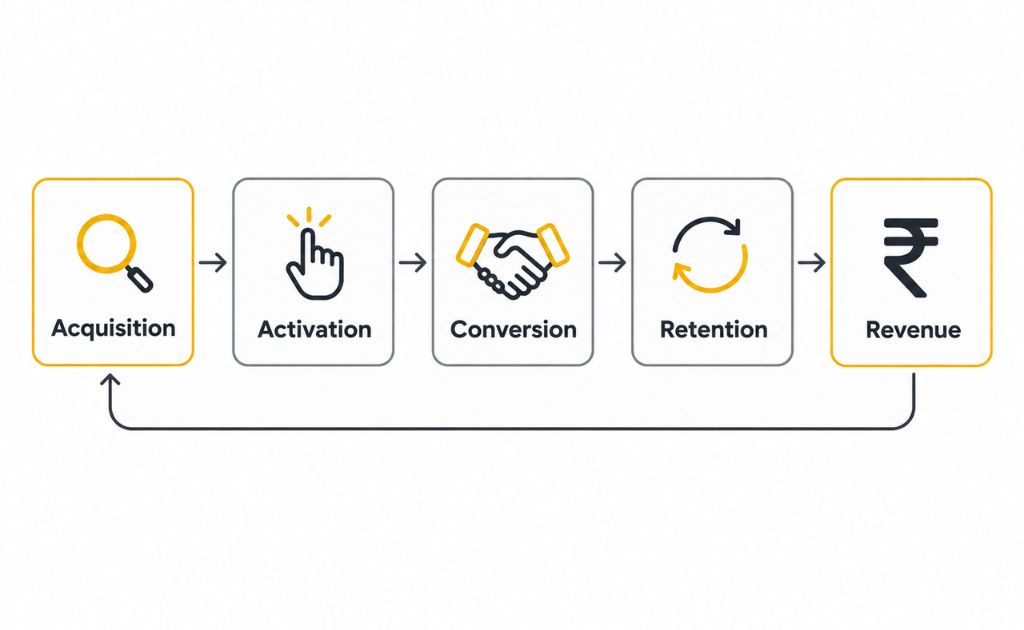
Growth marketing is organised around the customer journey as a system. The question is “where, across acquisition, activation, conversion, retention and revenue, is growth most constrained – and what is the cheapest, fastest way to find out whether we can fix it?” The unit of work is the experiment, and the scoreboard is business outcomes rather than channel metrics.
A short illustration (illustrative figures, not a client result): imagine a Chennai interior-design firm getting 400 website visits a month and 20 enquiries, of which 2 become projects. A digital marketer might propose more content and a bigger ad budget to reach 800 visits. A performance marketer might cut cost per enquiry. A growth consultant would first ask why 18 of 20 enquiries go nowhere – wrong budget range, slow follow-up, unclear pricing page? – because fixing enquiry-to-project conversion from 10% to 20% doubles revenue without spending another rupee on traffic. Only once that stage is working does more traffic make sense.
Where Growth Leaks: The Five Stages Worth Checking
Most growth problems live in one of five places. Which one matters most depends on your business model.
| Stage | What it means | Typical constraint by business type |
| Acquisition | How people discover you | Local service business: not visible for the searches that matter |
| Activation | The first meaningful action – an enquiry, a trial, a first order | SaaS/subscription: sign-ups that never reach the “aha” moment |
| Conversion | Enquiry or trial becomes a paying customer | B2B: leads arrive but sales follow-up is slow or unstructured |
| Retention | Customers stay, renew or return | Ecommerce/D2C: first orders are profitable only if a second order follows |
| Revenue | Average order value, margin, lifetime value | Everyone: growth that costs more than it earns is not growth |
A one-time service such as a wedding photographer has a very different retention question from a subscription business, and a B2B firm with a six-month sales cycle cannot judge a campaign in a fortnight. A sensible consultant adapts the model to the business rather than forcing the business into the model.
If the leak turns out to be a distinct search-visibility problem, that is a job for an SEO consultant. If it is leads arriving but not converting on the page, the deeper work sits with conversion rate optimisation. The growth consultant’s contribution is knowing which of those is true for you before the money is spent.
A Practical Growth Method
There is no secret framework here; this is a sensible sequence that most experienced growth practitioners follow in some form.
1. Establish the baseline
Agree the business goals, list every marketing activity currently running and what it costs, define the customer segments, and map the current funnel numbers stage by stage. Just as important: check whether the tracking can be trusted. If enquiries come through WhatsApp and phone calls and none of that is recorded, the “baseline” is a guess.
2. Find the constraint
Compare stage-to-stage conversion against what is reasonable for your model, and look at where existing spend is not producing the intended business result. One constraint at a time. Trying to fix everything is the same as fixing nothing.
3. Prioritise opportunities
Score candidate initiatives on likely impact, confidence that it will work, and effort or cost – with a note on dependencies (you cannot optimise a landing page that has no traffic). The ranking is a conversation, not a formula, but writing it down stops the loudest idea winning by default.
4. Design experiments
For each priority, write down the problem, the proposed change, the metric that defines success, the time window, and – before it starts – the result that would make you keep it and the result that would make you drop it. Deciding this up front prevents results being argued into a win afterwards.
5. Measure and interpret
Use analytics, CRM and sales data together, not just the ad platform’s own reporting. Be honest about attribution limits, small sample sizes and seasonality. “We don’t know yet” is a legitimate finding.
6. Scale what works
Increase investment only when the evidence supports it, then keep watching lead quality, acquisition cost and margin as volume rises. Many things that work at ₹50,000 a month stop working at ₹5 lakh.
Metrics That Support Decisions (and Metrics That Don’t)
The most common failure in marketing reporting is measuring activity and calling it outcome.
- Traffic tells you about reach, not about whether the right people arrived.
- Click-through rate tells you an ad is relevant to the search, not that the click is profitable.
- Lead volume can rise while lead-to-customer conversion falls – which usually means the new leads are worse, not that marketing improved.
- Revenue can grow while profit shrinks if acquisition cost rises faster than order value.
- Retention is make-or-break for a subscription product and nearly irrelevant for a once-in-a-lifetime purchase.
Two practical foundations make better metrics possible. First, define the actions that genuinely matter to the business – an enquiry form, a call, a purchase – and track them as key events in Google Analytics; Google’s own guidance on conversions versus key events in Google Analytics explains the distinction and why it matters for ad optimisation. Second, understand that any attribution model is a simplification: Google’s introduction to attribution in Google Analytics describes how credit is assigned across touchpoints, and no model captures a phone call that happened because of a brand search three weeks after a Facebook ad.
The metrics a consultant settles on for you should be few, business-level, and comparable month to month: cost per qualified lead or per customer, lead-to-customer rate, average order or project value, repeat rate where relevant, and the ratio of what a customer is worth to what it cost to win them.
Growth Experiments: Hypotheses, Prioritisation and Decision Rules
An experiment is not “let’s try a new creative and see”. It is a structured bet with a written hypothesis: If we change X for audience Y, then metric Z should move by at least N within T weeks, because of reason R.

A few principles that separate useful experimentation from theatre:
- One variable at a time, where the data allows. Changing the offer, the landing page and the audience together tells you nothing about which one mattered.
- Match the test to the traffic. A page with 300 visits a month cannot support a statistically meaningful A/B test; a qualitative review, user recordings or a bolder redesign may be more appropriate. The CRO article on this site covers the traffic thresholds in more detail.
- Set the decision rule before the test. “Keep if cost per qualified lead falls by 20% or more over four weeks; otherwise revert.”
- Keep a backlog. Ideas that were not prioritised this quarter should not be lost.
- Review on a rhythm. Fortnightly or monthly, look at what ran, what it showed, and what it changes about the next priority.
Experimentation is where a growth consultant and the specialists meet. The consultant frames the hypothesis and the decision rule; a Google Ads specialist, a developer or a content team may execute it.
When It Makes Sense to Bring in a Growth Marketing Consultant
Consulting of this kind is a good fit when:
- You are already spending meaningfully on marketing but cannot say which activities produce profitable customers.
- Several channels or vendors are running and nobody owns the overall picture.
- Results have plateaued and the instinct is “spend more”, but you are not confident it will work.
- Leads or sign-ups are rising while sales are not.
- You are about to make a large marketing investment and want the priorities tested before committing.
It is a poor fit when:
- You have almost no marketing activity or data yet – you need a foundation first, not a diagnosis of nothing.
- The constraint is clearly one channel and you know it (fix the Google Ads account; you do not need a strategist to tell you that).
- There is no one internally – or no agency – who can act on the recommendations. Diagnosis without execution capacity is an expensive report.
- The real problem is product, pricing or service quality. A consultant may help you see that, but marketing cannot fix it.
Consultant vs Agency vs Fractional CMO vs Specialist
| Growth marketing consultant | Growth / digital marketing agency | Fractional CMO | Channel specialist (SEO, Ads, CRO) | |
| Primary contribution | Diagnosis, prioritisation, experiment design, decision-making | Execution capacity across channels | Part-time marketing leadership: strategy, team, budget ownership | Deep execution in one discipline |
| Scope | The whole growth system; usually not day-to-day channel management | Whatever is in the retainer; often strongest in the channels it sells | The entire marketing function, including people | One channel, done well |
| Choose this if… | You have activity and some data but no clear picture of what is constraining growth | You know what needs doing and lack hands to do it | You need ongoing leadership and management, not a project | You have correctly identified a single-channel problem |
| Watch out for | Recommendations nobody executes | Channel bias in the diagnosis | Cost and commitment beyond what a smaller business needs | Optimising a channel that is not the real constraint |
These are tendencies, not rules. Many consultants execute, many agencies offer strategy, and the honest position is that the right choice depends on what you already have in place. A common and sensible path is: diagnose with a consultant, then execute with an agency or in-house team against the priorities that diagnosis produced.
Common Mistakes Businesses Make When Trying to Grow
- Buying traffic before fixing conversion. The most expensive mistake in the list, because it scales the leak.
- Judging marketing by platform dashboards alone. Ad platforms report their own success generously; the CRM and the bank account are the real scoreboard.
- Running too many initiatives at once. Nothing gets enough attention or enough data.
- Changing direction monthly. Many growth levers – SEO, retention, brand – need a quarter or more to show anything.
- Treating “more leads” as the goal. The goal is more profitable customers; sometimes that means fewer, better leads.
- Ignoring the offline half of the funnel. In Chennai and across India, a large share of enquiries arrive by WhatsApp and phone. If those are not logged and followed up systematically, the digital numbers are only half the story.
How I Approach Growth Consulting
I work as a brand and digital marketing strategist with over a decade in the field and run Notion Graffiti, a creative marketing agency in Chennai. That combination shapes how I consult: I would rather spend the first conversation finding out what is actually holding growth back than assume the answer is one of the services the agency happens to sell.
In practice an engagement starts with the baseline and the constraint, as described above. Where the fix is a positioning problem, the work moves towards brand strategy; where it is paid acquisition, towards a Google Ads review; where it is enquiries that do not become customers, towards the lead generation and follow-up process. Where a business needs a full execution team, Notion Graffiti can provide it – but that is a decision the diagnosis should drive, not the other way round.
Frequently Asked Questions
What does a growth marketing consultant do?
They examine the full customer journey – from acquisition to repeat revenue – find the stage that is most limiting growth, prioritise what to fix, design experiments to test the fix, and measure results against business outcomes rather than channel activity. They advise on channels but their core job is deciding which problem to solve first.
How is a growth marketing consultant different from a digital marketing consultant?
A digital marketing consultant is typically organised around setting up and coordinating channels. A growth consultant is organised around the system those channels feed, and spends more time on diagnosis, prioritisation and experimentation. The roles overlap, and the same person can do both; the difference is the starting question.
Is growth marketing the same as performance marketing?
No, though they are related. Performance marketing focuses on paid acquisition efficiency – cost per lead, cost per acquisition, return on ad spend. Growth marketing covers that stage but also activation, conversion, retention and revenue, and is as likely to recommend fixing follow-up or pricing as changing an ad.
Is a growth marketing consultant the same as a growth hacker?
“Growth hacking” usually describes fast, tactic-heavy experimentation, often in early-stage tech products. Growth marketing consulting applies similar experimental thinking but with more emphasis on measurement discipline, business economics and sustainability. The vocabulary differs more than the underlying approach.
When should a business hire a growth marketing consultant?
When there is real marketing activity and some data, but no clear understanding of which efforts produce profitable customers – especially if results have plateaued, several vendors are involved, or a large investment is about to be made. If you have no marketing yet, start with the basics first.
Is growth marketing suitable for small businesses?
Yes, provided the business has enough activity to diagnose. The method scales down well: a small clinic or a home-services company benefits as much from knowing which of its five lead sources produces paying customers as a SaaS company does from activation analysis. What changes is the metrics and the pace, not the logic.
How does a growth marketing consultant measure success?
Against a small set of business-level metrics agreed at the start: cost per qualified lead or customer, lead-to-customer rate, order or project value, repeat rate where relevant, and the relationship between what a customer costs to win and what they are worth. Traffic and engagement are tracked but are not the scoreboard.
How do I choose a growth marketing consultant in Chennai?
Ask how they would find your constraint before they propose any tactic, what metrics they would use and why, how they handle WhatsApp and phone enquiries in tracking, and what a decision rule for an experiment looks like. Be cautious of anyone who leads with a service list, promises a guaranteed outcome, or reports only platform metrics.
Ready to Find Out What Is Actually Limiting Your Growth?
If you recognise the pattern – plenty of marketing, unclear results – the most useful next step is a conversation about your current numbers and where they break down. Use the contact form to tell me a little about your business and what you are trying to grow, and we can decide together whether growth consulting, a specialist, or an execution team is the right fit.