A business can be winning on paper and still losing money. Rankings are up, ads are delivering clicks, the website looks better than the competition’s – and the enquiries stay flat, or the ones that arrive are the wrong people asking the wrong questions.
That gap between traffic and customers is where conversion rate optimization lives. A conversion rate optimization expert studies where the journey breaks down, works out why, and uses evidence, testing and structured iteration to improve the actions that actually matter to the business.
This guide covers what the work involves, when it’s worth paying for, when it isn’t, and how to tell a real specialist from someone selling button colours.
Table of Contents
What Does a Conversion Rate Optimization Expert Do?
A CRO expert helps you increase the percentage – and the quality – of visitors who take a desired action, by analysing behaviour, identifying friction, forming hypotheses, testing changes and measuring the business outcome. Depending on the business, that action is a purchase, a qualified enquiry, a booking, a consultation, a signup or a subscription.
What it isn’t is redecoration. A designer asks “does this look right?” A CRO expert asks “where are people dropping out, why, and what does the evidence say we should try first?”
CRO Expert, Consultant or Specialist: Does the Title Matter?
Not much. These titles are used interchangeably across the industry, and the label tells you far less than the engagement model does.
| Term | What it usually signals |
| CRO expert | Broad label for someone experienced in conversion optimization |
| CRO consultant | Usually emphasises diagnosis, strategy and recommendations |
| CRO specialist | Usually implies hands-on research and experimentation work |
| CRO agency | Team model combining research, UX, analytics and implementation |
Before comparing quotes, settle one question: are you buying a diagnosis, or are you buying execution? A consultant may hand you a prioritised list your team implements. A specialist or agency may build and ship the changes. Both are legitimate. Paying for one while expecting the other is where most disappointment starts.
Why More Traffic Doesn’t Mean More Customers
You can grow organic, paid, social and referral traffic without growing customers proportionally. The usual causes:
- The traffic is wrong – right keywords, wrong buyer
- The value proposition isn’t clear within a few seconds
- The landing page doesn’t match the promise in the ad or search result
- The call to action is vague, buried, or asks for too much too soon
- The form is long, confusing, or fails silently on mobile
- There’s no reassurance – no proof, no pricing signal, nothing that says “this is a real business”
- The page is slow on a mid-range phone on mobile data
- The lead arrives fine, but nobody follows up quickly
The expert’s job is to establish which of these is actually happening, not to fix all of them on instinct.
What a CRO Expert Analyses
Not every project needs every row. A good audit starts by deciding which few matter most here.
| Area | What gets examined |
| Traffic | Source, intent, device, audience quality |
| Landing pages | Message match, structure, clarity, CTA |
| User experience | Confusion, friction, navigation, hierarchy |
| Forms | Field count, completion rate, validation errors |
| Checkout | Drop-off points and unnecessary steps |
| Trust | Reviews, proof, guarantees, reassurance |
| Content | Objections answered, value proposition clarity |
| Mobile | Usability and speed on real devices |
| Funnel | Stage-by-stage drop-off |
| Tracking | Event accuracy and how conversion is defined |
How a CRO Expert Studies User Behaviour
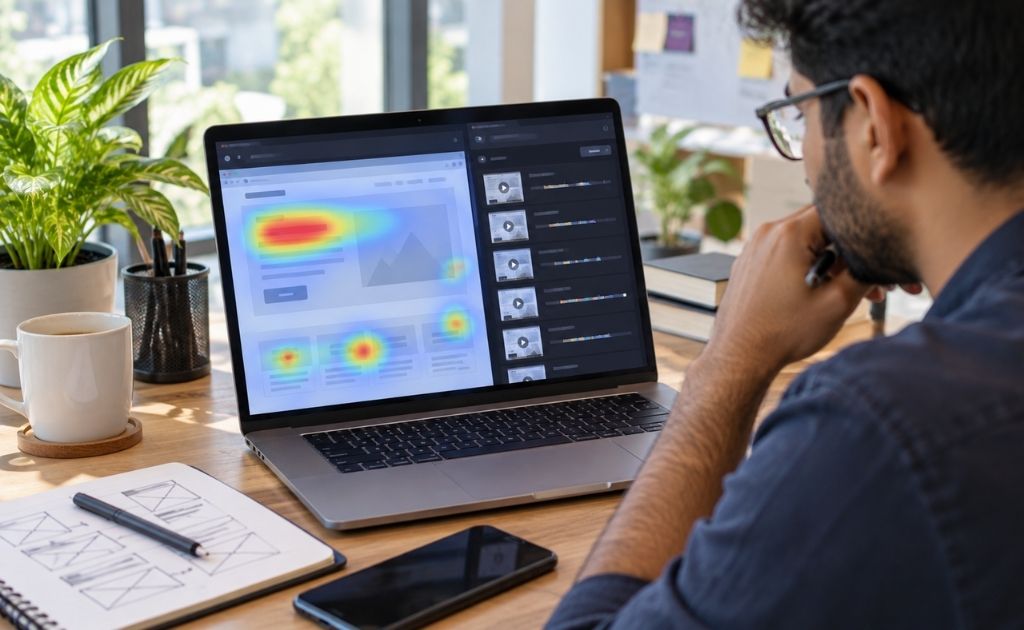
Serious CRO work combines two kinds of research, because one without the other is confident guessing.
Quantitative research answers “what is happening?” – GA4 reports, funnel drop-off, device and source segments, page-level conversion rates. It tells you that most mobile visitors abandon the enquiry form. It cannot tell you why.
Qualitative research answers “why might it be happening?” – session recordings and heatmaps showing where people click, scroll and hesitate; on-site surveys; customer interviews; and usability testing, which exposes real problems with a handful of participants rather than a huge sample.
The process that follows is fairly consistent:
- Understand the business – the offer, the buyer, the margins, the sales process, and what genuinely counts as a conversion.
- Audit the analytics – traffic, landing pages, funnels, devices, sources, and whether the conversion events can be trusted at all.
- Study behaviour – recordings, heatmaps, form analytics, surveys.
- Locate friction – where people stop, hesitate or get confused.
- Write hypotheses – testable propositions, not conclusions. “If the primary offer is clearer above the fold, more high-intent visitors may reach the enquiry step” is a hypothesis. “Our headline is bad” is an opinion.
- Prioritise – by potential impact, strength of evidence, and effort to implement.
- Test or implement – depending on whether traffic supports a valid experiment.
- Record what was learned, including the losses and what they ruled out.
- Iterate. CRO is a process, not a project with an end date.
Landing Pages, Forms and CTAs: Where Friction Hides
On a landing page the question is never “what should we change?” It is: why did this visitor come, what were they expecting, and what is stopping the next step? That covers the headline, the message match, the offer, the proof, the unanswered objections, the CTA, the form and the mobile experience.
On forms, the usual suspects are unnecessary fields, unclear labels, validation errors that explain nothing, and mobile keyboards that make a phone field painful. But “shorter forms always convert better” is one of the most expensive myths in this business. A shorter form usually produces more leads and often produces worse ones. The right length depends on what your sales team needs in order to qualify someone.
On calls to action, the button is the smallest part. What matters is the offer behind it, the wording, the placement, and whether the visitor can tell what happens next. “Submit” says nothing. “Get a free 20-minute site review” states the commitment, the value and the time cost.
Trust Is a Conversion Factor, Not a Design Detail
A large share of the enquiries you never receive are lost to uncertainty rather than usability. The visitor is silently asking: who is actually behind this business? What happens after I submit – does someone call me, and when? What does this cost, even roughly? Is my information safe?
Finding the moments where reassurance is needed and missing is core CRO work. It’s also where conversion problems turn out to be positioning problems – if a business can’t explain who it’s for and why it’s different, no layout change rescues that. Working with a brand strategy consultant on messaging can move conversion further than a year of page tweaks.
A/B Testing and Experimentation

A/B testing compares two versions of an experience to see whether a meaningful change affects the conversion metric you care about – headline, offer, CTA, form design, page structure, proof placement, product presentation.
The sequence that makes a test worth running is always evidence → hypothesis → test → measurement → learning. Tests that skip the evidence step are expensive opinions with a dashboard attached. Testing everything is not a strategy; most sites have a handful of pages where an experiment justifies the traffic it consumes, and a long tail where it doesn’t.
When A/B Testing Is Not the First Step
This is the part most CRO pages leave out, and it decides whether the money is well spent. Testing shouldn’t be the starting point when:
- Traffic is too low for a valid result. Testing platforms commonly point to something in the region of 10,000 visitors per variation and around 1,000 conversions before a test yields conclusive evidence (Convert). Plenty of Indian service businesses run a few thousand sessions and a few dozen enquiries a month. “Tests” at that volume produce noise you can be talked into believing.
- Conversion tracking is unreliable. If the events are wrong, every result is wrong.
- The funnel is visibly broken. You don’t test a form that fails on mobile. You fix it.
- Nobody has defined the primary conversion. If the team can’t agree on what success is, an experiment can’t measure it.
None of that means CRO has nothing to offer a lower-traffic business. It means the work shifts to audits, user research, usability fixes, funnel repair, message clarity and corrected measurement – all of which compound without needing statistical significance.
Conversion Tracking, Lead Quality and the WhatsApp Problem
A CRO expert has to know what happened after the click, which means conversion actions are defined and tracked properly before anything gets optimised: form submissions, calls, WhatsApp enquiries, bookings, demo requests, purchases. In GA4 these are configured as key events, and getting those definitions right is unglamorous work that nearly everything else depends on.
Two layers are worth separating:
- Micro conversions – CTA clicks, WhatsApp taps, form starts, brochure downloads. Useful signals.
- Macro conversions – a purchase, a qualified enquiry, a booking, a subscription. What the business is actually paid for.
Optimise around clicks and you will reliably produce more clicks and no more revenue. The chain that matters runs traffic → intent → landing experience → conversion → qualified conversion → customer → revenue, and an expert should be able to say which link they’re working on.
For many Indian service businesses WhatsApp is a real conversion path and should be measured alongside forms and calls – otherwise a meaningful share of enquiries is invisible and the site looks like it’s underperforming when it isn’t. The same discipline applies to quality: a jump in enquiry volume that fills your sales team’s day with unqualified conversations is not a CRO win. When that’s the pattern, the problem is often upstream, which I’ve covered in my guide to hiring a lead generation expert in Chennai.
CRO vs SEO, Google Ads and UX Design
| Discipline | What it owns |
| SEO | Bringing relevant organic traffic and satisfying search intent |
| Google Ads | Buying qualified traffic at a controllable cost |
| UX design | The quality and usability of the experience |
| CRO | What happens after arrival, measured against business outcomes |
These overlap more than they compete. SEO and CRO are complementary – a page should satisfy the query and make the next action obvious. Paid traffic is where CRO pays back fastest, because you’re already paying per click; that’s why a good Google Ads expert in Chennai cares about landing page relevance and conversion tracking as much as bids.
CRO borrows UX methods but judges them differently: UX asks whether the experience is good, CRO asks whether it produced a measurable result. And a redesign is not a conversion strategy – a rebuild changes hundreds of variables at once, so if conversion drops afterwards nobody can say which change caused it. Research sometimes justifies a redesign. It shouldn’t be the opening move.
Do You Actually Need a CRO Expert Yet?
Signals that you’re ready: the site already receives meaningful, relevant traffic; paid campaigns are running with real spend; landing pages get visits but few enquiries; checkout or form abandonment is visible; conversion tracking is disputed; the team argues about design from opinion rather than data; or a redesign is being discussed before anyone has diagnosed the problem.
Signals that it isn’t your first problem: almost no relevant traffic yet; an unclear offer or market; analytics that was never set up properly; serious technical or speed issues; no agreed conversion event; or a product and pricing problem wearing a marketing costume.
CRO cannot create demand that doesn’t exist or rescue an unclear business model. Anyone who tells you otherwise is selling. If acquisition is the real gap, that’s a broader strategy conversation – closer to the work of a digital marketing consultant in Chennai than a conversion specialist.
CRO Looks Different by Business Model
| Business model | Primary conversion | Usual CRO focus |
| E-commerce | Purchase | Product pages, cart, checkout friction |
| B2B | Qualified enquiry or demo | Message clarity, proof, form qualification |
| Local service | Call, WhatsApp or booking | Mobile speed, trust, contact paths |
| Healthcare | Appointment | Reassurance, privacy, booking flow |
| SaaS | Trial or signup | Onboarding, pricing clarity, activation |
| Education | Application or enquiry | Course clarity, fees, counsellor handover |
There is no single CRO checklist that works across these. The starting point is the business model, the customer journey and the economics – in that order.
What Does a CRO Expert Cost?
Anyone quoting a price before seeing your traffic, tracking and funnel is guessing, and published rates vary enormously by market and engagement model. What actually drives the number: audit scope and how many funnels are involved; traffic volume and whether experimentation is viable at all; whether analytics has to be rebuilt first; how many experiments are planned; whether design and development are included; depth of reporting; and engagement length, since a one-off audit prices very differently from an ongoing programme.
Get scope in writing before comparing two quotes. Most price gaps in CRO proposals are scope gaps.
How to Choose a Conversion Rate Optimization Expert
Ten questions for the first call. Listen for the shape of the answer, not just the content.
- How will you identify our conversion problems? You want a research process, not a list of best practices.
- What data and tools will you use – and how will you verify the data is trustworthy?
- How do you decide what to test first? Look for prioritisation by impact, evidence and effort.
- How will you know whether a result is meaningful? If traffic can’t support testing, a good expert says so upfront.
- Who implements the changes – you or us? Get it in writing.
- How will you verify conversions are tracked correctly? This belongs before optimisation, not after.
- Do you measure qualified leads and sales, or only clicks? The answer tells you what you’re actually buying.
- What will I receive each month? Ask to see a sample report.
- Can you show relevant, verifiable work, including tests that failed and what they taught you?
- Who owns the accounts, data and test history? The only acceptable answer is that you do.
Red Flags
Be careful with anyone offering guaranteed conversion increases or revenue growth; “2X your conversions” promises made before any audit; button-colour advice presented as strategy; weekly tests with no research behind them; reports built on clicks and impressions; CRO work starting before tracking is verified; no baseline measurement, so improvement can’t be proven either way; or recommendations that could have been written without ever seeing your site.
How I Approach Conversion
I’m Amjad Moulana, founder of Notion Graffiti, a Chennai-based agency working across brand strategy, performance marketing, SEO, design and web development.
I don’t treat conversion as a standalone service, because in practice it rarely is one. The chain runs from search and ads, through the landing experience and the enquiry, to qualification and the business outcome – and a weak link anywhere makes every other link look like the problem. Businesses regularly arrive convinced the website is failing when the traffic is mismatched, or convinced the ads are failing when the landing page never answered the question the ad raised.
So the first thing I check is usually the least interesting one: whether the conversion event is recorded correctly at all. A surprising number of “our conversions dropped” conversations end right there.
If you want a straight answer about where your own journey loses people, bring your numbers – traffic, current conversion rate, cost per lead, whatever you have – and we’ll go through them together.
Frequently Asked Questions
What does a conversion rate optimization expert do?
They analyse how visitors behave on your site, identify where and why people drop out, form hypotheses, test or implement improvements, and measure the effect on business outcomes such as qualified leads, bookings or sales.
What is the difference between a CRO expert and a CRO consultant?
In practice, very little – the titles are used interchangeably. A consultant more often diagnoses and recommends while your team implements; a specialist may also do the hands-on work. Confirm the engagement model rather than the label.
What does a CRO audit include?
Usually an analytics and tracking review, funnel and drop-off analysis, landing page and form assessment, behaviour research such as heatmaps and session recordings, and a prioritised list of opportunities with the reasoning behind each one.
Does CRO always require A/B testing?
No. Testing needs enough traffic and conversions to produce a reliable result. Below that threshold, CRO delivers value through audits, user research, usability and funnel fixes, and corrected measurement.
How much traffic do I need for A/B testing?
Testing platforms commonly cite roughly 10,000 visitors per variation and around 1,000 conversions for conclusive results. Below that, focus on research-led improvements rather than formal experiments.
Is CRO the same as SEO?
No. SEO brings relevant visitors from search; CRO improves what happens once they arrive. They work best together on the same page.
How does CRO work with Google Ads?
Ads control traffic quality and cost; CRO controls what that traffic does next. Because you pay per click, landing page and tracking improvements usually show up faster in paid campaigns than anywhere else.
Is CRO the same as UX design?
No. CRO uses UX research methods but evaluates changes against measurable business outcomes rather than experience quality alone.
How much does a CRO expert cost?
It depends on audit scope, traffic volume, whether tracking needs rebuilding, how many experiments are planned, whether implementation is included, and engagement length. Ask for scope in writing before comparing quotes.
When should I hire a CRO expert?
When you already have relevant traffic, a defined conversion, and a visible gap between visits and enquiries or sales – and before you commission a redesign to solve a problem nobody has diagnosed.