

A sales funnel consultant looks at the whole path a prospect takes, from the first time they notice your business to the moment they pay you, and works out where people are being lost along the way. The work is diagnostic first: which stage leaks the most, why, and what should be fixed before anything else. Only then does it become advisory.
That is a different job from running ads, redesigning a landing page or writing email sequences. Those are tactics that live inside the funnel. A funnel consultant is responsible for the connections between them, especially the parts that marketing agencies rarely see, such as how fast an enquiry is answered, who decides whether a lead is worth pursuing, and what happens to a proposal that has gone quiet.
If your business gets enquiries but too few of them become customers, this guide will help you understand what the role involves, how a proper funnel audit works, which numbers tell the truth, and whether you need outside help at all.
Before reading on, think about your own business for a moment: do you know at which stage most of your prospects go quiet? If you cannot answer that from data, that gap is usually the first thing worth fixing, and this article shows how.
Table of Contents
What a sales funnel consultant actually does
Most businesses already have a funnel, even if nobody has drawn it. Someone sees an Instagram post or a Google result, visits the website, sends a WhatsApp message, gets a call back (or does not), receives a quote, thinks about it, and either buys or disappears. A sales funnel consultant turns that informal sequence into something you can see, measure and improve.
In practice, the work covers four areas:
- Mapping. Writing down the real stages a prospect passes through, which channels feed them, which person or system owns each stage, and where handoffs happen between marketing and sales.
- Measuring. Establishing how many prospects enter each stage and how many move to the next, and checking whether the tracking and definitions behind those numbers can be trusted.
- Diagnosing. Finding the stage with the largest or most expensive drop-off and investigating the cause, which could be audience quality, offer clarity, enquiry friction, slow response, weak qualification, poor follow-up or a pricing or product issue.
- Prioritising. Recommending a short, ordered list of changes with a way to tell whether each one worked, rather than a long list of everything that could be better.
Some consultants also implement the changes or coordinate the people who do. Others hand over a plan for your team to execute. Both are legitimate models; what matters is that the scope is clear before you start.
How a sales funnel works from first contact to sale
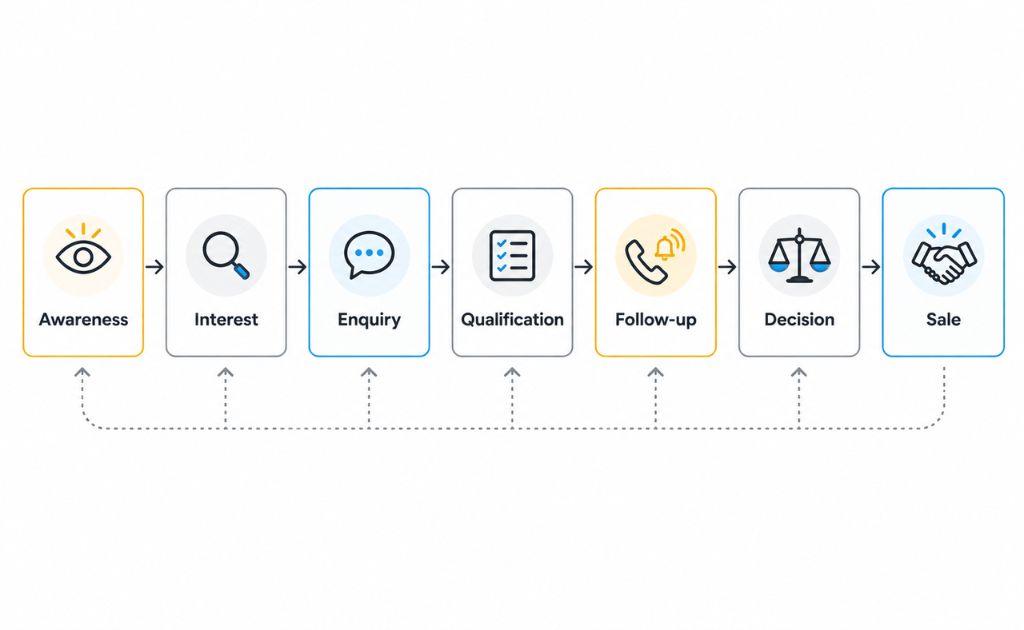
A simple, business-friendly version of the journey looks like this:
Awareness → Interest → Enquiry → Qualification → Follow-up → Decision → Sale
- Awareness: the prospect learns you exist through search, ads, social media, referrals or a hoarding on the road.
- Interest: they look closer: your website, your Google reviews, your Instagram profile.
- Enquiry: they make contact through a form, call, WhatsApp, DM or walk-in.
- Qualification: someone decides whether this person has a real need, budget, authority and timeline, and what to do next.
- Follow-up: quotes, demos, site visits, samples, reminders and the conversations in between.
- Decision: the prospect compares, negotiates, consults family or colleagues, and chooses.
- Sale: payment, onboarding, and ideally a referral later.
The labels change by business model. A pure-veg restaurant in Chennai has a funnel that lasts an afternoon: see the page, check the menu, book a table. A B2B manufacturer may run a six-month funnel with RFQs, factory visits and procurement approvals. A SaaS company has trials, activation and upgrades. An ecommerce store has product pages, carts and checkout. Salesforce’s own guide to the sales funnel describes a six-stage model from awareness through evaluation to purchase, which is a useful reference, but the right stages for you are the ones your prospects actually pass through.
Two things to keep in mind. First, buyer journeys are not neat. People research, leave, come back three weeks later through a different channel, ask a question on WhatsApp, go silent, then buy after a referral. A good consultant builds the funnel around this reality instead of a straight line. Second, no single funnel structure is mandatory. If a stage in your diagram has no owner and no measurement, it probably should not be a stage.
Where prospects are usually lost
In my experience the leak is rarely where the business thinks it is. The website gets blamed when the real problem is three steps later. The usual suspects, roughly in journey order:
- The wrong people are entering. Broad targeting, misleading ad copy or ranking for the wrong search terms fills the top of the funnel with enquiries that were never going to buy.
- The promise and the page do not match. The ad says one thing, the landing page leads with something else, and the visitor has to work out whether they are in the right place.
- The offer is unclear. Visitors cannot tell what you do, for whom, at roughly what price, or what happens after they enquire.
- Enquiring is harder than it needs to be. A long form, a broken mobile layout, no WhatsApp option for an audience that lives on WhatsApp.
- Nobody responds quickly. Research published in the Harvard Business Review found that most companies respond to online leads far too slowly, and that delay costs them the contact. Indian service businesses are no exception: an enquiry answered the next morning is often answered after the prospect has already spoken to two competitors.
- Qualification is inconsistent or absent. Every lead gets the same effort, so the sales team spends its day on people who cannot buy and loses the ones who can.
- Follow-up stops after one attempt. Quotes are sent and never chased. Site visits happen and nothing is scheduled afterwards. Nobody owns the “thinking about it” stage.
- Marketing and sales use different words. Marketing counts a form fill as a lead; sales counts a lead only after a conversation. Reports disagree, and nobody can say where the problem is.
- The data is wrong. Conversion events were set up once and never checked, calls and WhatsApp enquiries are not tracked, and the spreadsheet depends on whoever remembers to update it.
- The problem is not marketing at all. Pricing, product fit or delivery capacity can make a perfectly good funnel look broken.
A consultant’s first job is to identify which of these is actually happening to you, not to fix all ten on instinct.
How a sales funnel audit works
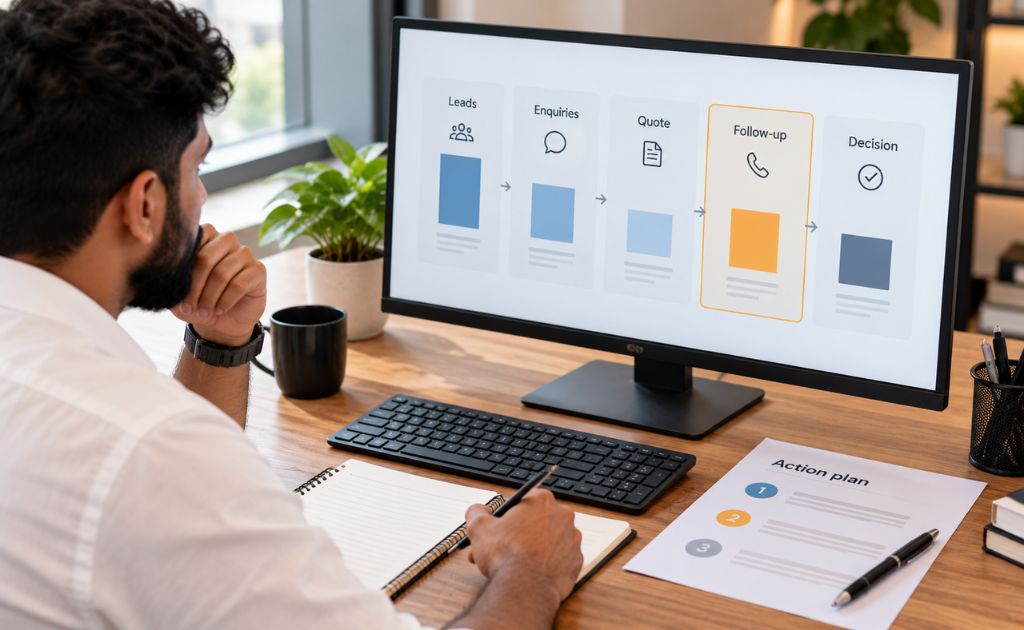
Here is a practical seven-step process you can follow yourself. It is not a proprietary method, just the sequence that keeps the work honest.
Step 1: Map the real buyer journey
Document what actually happens, not the process in the training manual. Which channels bring enquiries? Where do they land: inbox, WhatsApp, CRM, a phone that one person carries? Who picks them up? What do they do next? Where does a lead pass from marketing to sales, and what information travels with it? Interview the people who handle enquiries; their version is usually more accurate than the owner’s.
Step 2: Set a baseline
For each stage, count how many prospects entered and how many moved forward over a sensible period, usually the last three to six months. Agree definitions in writing: what counts as an enquiry, a qualified lead, an opportunity, a sale. Then check whether the tracking supports those numbers. Google Analytics, for example, only reports what you have marked as a key event, so if WhatsApp taps and phone calls were never configured, the “website conversion rate” is a fraction of the truth. If the data is unreliable, fixing measurement becomes step one of the plan.
Step 3: Find the bottleneck
Look at the stage-to-stage conversion rates and the time spent in each stage. The bottleneck is the stage that loses the most relevant prospects or creates the longest delay. Judge it by business impact: losing 30% of qualified leads between quote and decision usually matters more than losing 60% of unqualified traffic on a landing page.
Step 4: Investigate the cause
Go beyond the number. Read the enquiries that went nowhere. Listen to a few sales calls. Compare the ad or search listing to the page it sends people to. Check how long first responses take. Ask the sales team what they hear when prospects say no. A low proposal-to-sale rate can come from pricing, from a slow quote, from a competitor’s better follow-up, or from the wrong leads being quoted in the first place, and each needs a different fix.
Step 5: Prioritise improvements
Rank the candidate changes by expected impact on the bottleneck, how confident you are in the diagnosis, effort, cost and what else has to happen first. A one-day change to the response process often beats a two-month website rebuild.
Step 6: Test the change
Before you implement, write down what you expect to improve, by how much, over what period, and what result would make you keep, adjust or abandon the change. Formal A/B testing needs volume most Indian SMEs do not have; a before-and-after comparison with a clear hypothesis is usually the realistic option.
Step 7: Review and refine
After the observation period, compare the stage numbers against the baseline. Keep what moved the business metric, not just the stage metric, and go back to step 3 for the next bottleneck.
A hypothetical example
Consider an interior design firm in Chennai that gets around 80 enquiries a month from Google Ads and Instagram and signs four to five projects. The owner wants a new website. Mapping shows that enquiries arrive on a shared WhatsApp number, replies take anywhere from ten minutes to a day depending on who is free, and every enquiry gets a site-visit offer regardless of budget. Quotes are sent after the visit; about a third are never chased. The bottleneck is not the website. It is the combination of slow first response, zero qualification and abandoned quotes. The first changes would be a response-time standard with a named owner, three qualifying questions before offering a visit, and a simple quote follow-up schedule. Only after those are stable would the website become the next priority. Numbers in this example are illustrative, not client results.
If you recognised your own business somewhere in steps 1 to 4, that is usually enough to know where to start. If you would rather talk it through, you can book a free 1:1 consultation with me and bring whatever numbers you have.
Measuring the funnel: which numbers belong to which stage
Not every business needs every metric. Pick the ones that match your funnel and your data, and keep four categories separate so they cannot be confused for each other.
| Category | What it tells you | Typical measures |
| Marketing activity | How much is going in at the top | Impressions, clicks, visits, cost per click, lead volume |
| Funnel progression | How well prospects move between stages | Lead qualification rate, enquiry-to-meeting rate, meeting attendance, quote-to-sale rate, time to first response, days in each stage |
| Sales outcomes | What the business actually won | Customers acquired, opportunity-to-customer conversion, average deal value, sales cycle length |
| Financial outcomes | Whether it was worth it | Cost per qualified lead, customer acquisition cost, revenue from qualified leads, customer lifetime value where you can measure it reliably |
A few rules that save a lot of arguments. More leads do not automatically mean more sales; if qualification rate falls as volume rises, you may be paying for noise. Analytics tools do not reveal every interaction, and they cannot prove that one change caused a result, so treat the numbers as evidence to interpret, not verdicts. And make sure the person responsible for a stage can see that stage’s number; a metric nobody owns does not improve.
How a sales funnel consultant differs from related roles
The titles overlap, and a single person can wear more than one hat. The useful question is which part of the journey each role is accountable for.
| Role | Primary focus | Call them when |
| Sales funnel consultant | The full path from enquiry to customer: stages, qualification, follow-up, handoffs, measurement | Enquiries exist but conversion to customers is poor, and nobody knows which stage is failing |
| Digital marketing consultant | Overall online strategy and channel mix: SEO, ads, social, content, brand | You need direction on where to invest across channels, not just conversion |
| Conversion rate optimisation specialist | The proportion of visitors who complete a specific on-site action, through research, usability fixes and testing | Traffic is healthy, tracking is reliable, and the website or checkout itself is the suspected leak |
| Digital marketing agency | Execution across channels with a team | Several layers need building at once and you want one accountable team doing the work |
| Sales consultant | Sales strategy, team skills, scripts, negotiation, pipeline discipline | The funnel delivers qualified conversations and the sales team is not closing them |
A funnel consultant borrows methods from all of these. If the diagnosis points to on-page friction, the work looks like CRO; I have written separately about what a conversion rate optimisation expert actually does. If it points to lead quality at the top, the answer may be a better lead generation setup or tighter Google Ads targeting. If organic visitors arrive with the wrong intent, that is an SEO conversation. And if the business needs a broader plan before any of this, that is the territory of a digital marketing consultant.
When it makes sense to bring in a consultant
You probably need outside help with your funnel if several of these are true:
- You get a steady flow of enquiries but closing rates have been flat or falling for months.
- Marketing says leads are good; sales says leads are bad; nobody has data to settle it.
- Response time depends on who is free rather than a standard.
- Quotes and proposals go out and nobody can say how many are still open.
- You are about to spend on a website redesign or more ad budget without knowing which stage is actually failing.
- You have tried two or three agencies and each one fixed its own channel while the overall number did not move.
You probably do not need one yet if you have almost no enquiries (that is an acquisition problem first), if your offer or pricing is still unsettled, or if you can already see the bottleneck clearly and simply need to act on it.
What a funnel consulting engagement looks like
Scope varies by consultant, so ask for it in writing. A reasonable engagement usually includes:
- A documented funnel map with stages, owners, channels and handoffs
- A baseline with agreed definitions and a note on where tracking cannot be trusted
- The bottleneck diagnosis, with the evidence behind it
- A short, prioritised list of changes with expected effect, effort and success measure
- Clarity on who implements each change: you, the consultant, or an agency
- A review point after the observation period
Questions worth asking before you hire anyone: what information will you need from us before giving advice? How do you tell a traffic problem from a follow-up problem? What exactly will we receive? Who implements? How will we know if the diagnosis was right? Be cautious of anyone who promises a specific conversion lift before seeing your numbers, who recommends the same platform for every problem, or who talks only about the website and never about what happens after the form is submitted.
How I approach this work
I am Amjad Moulana, founder of Notion Graffiti, a Chennai-based marketing agency. Funnel consulting is where strategy and performance meet, and it is the work I find most useful for business owners because it answers a question they have usually been guessing at: where are we actually losing people?
I start with the least glamorous checks: whether enquiries are being counted correctly, how long they wait for a reply, and whether anyone qualifies them. Those three things explain a surprising number of “our marketing isn’t working” conversations. Because the agency covers brand, performance marketing, SEO, design and web, implementation can happen in one place when that is what the diagnosis calls for, but the diagnosis comes first and it is yours to act on however you choose.
Frequently asked questions
What does a sales funnel consultant do?
They map the path prospects take from first contact to purchase, measure how many move between stages, identify where and why the biggest drop-off happens, and recommend an ordered set of improvements with a way to measure each one. Some also oversee implementation.
What is included in a sales funnel audit?
Typically a funnel map, agreed stage definitions, a baseline of stage volumes and conversion rates, a check on tracking accuracy, a bottleneck diagnosis with supporting evidence, and a prioritised plan. The depth depends on how much data exists and how many funnels the business runs.
How is a sales funnel consultant different from a CRO specialist?
CRO concentrates on increasing the share of visitors who complete a specific on-site action, usually through research and testing. Funnel consulting looks across every stage, including qualification, response time, follow-up and the handoff to sales. The two overlap, and a funnel consultant may use CRO methods on one stage.
Can a sales funnel consultant improve lead quality?
Yes, when the diagnosis shows that the wrong people are entering the funnel or that nobody is qualifying them. Fixes range from tighter targeting and clearer offers to qualifying questions before a sales call. If the real issue is lead volume rather than quality, that becomes a lead generation project.
When should a business hire a sales funnel consultant?
When enquiries exist but conversion to customers is weak and the business cannot say which stage is responsible, especially before spending on a redesign or more ad budget.
How long does sales funnel optimisation take?
Mapping and baselining can be done in weeks if data exists; seeing the effect of a change depends on your sales cycle. A restaurant can judge a change in a fortnight; a B2B firm with a four-month cycle cannot. Be wary of anyone quoting a fixed timeline before looking at your business.
How do I choose a sales funnel consultant in Chennai?
Ask them to walk through how they would diagnose your funnel before they propose anything, check that they ask about your sales process and follow-up and not only your website, insist on clear deliverables and ownership, and prefer someone who will show you the evidence behind a recommendation rather than a guaranteed result.
Want a second opinion on your funnel?
If you are getting enquiries and losing too many of them somewhere between hello and payment, that gap is worth understanding properly before spending more on traffic. Book a free 1:1 consultation, bring whatever numbers you have — enquiry volume, close rate, response times, cost per lead — and we will go through where the funnel is leaking and what deserves attention first.